
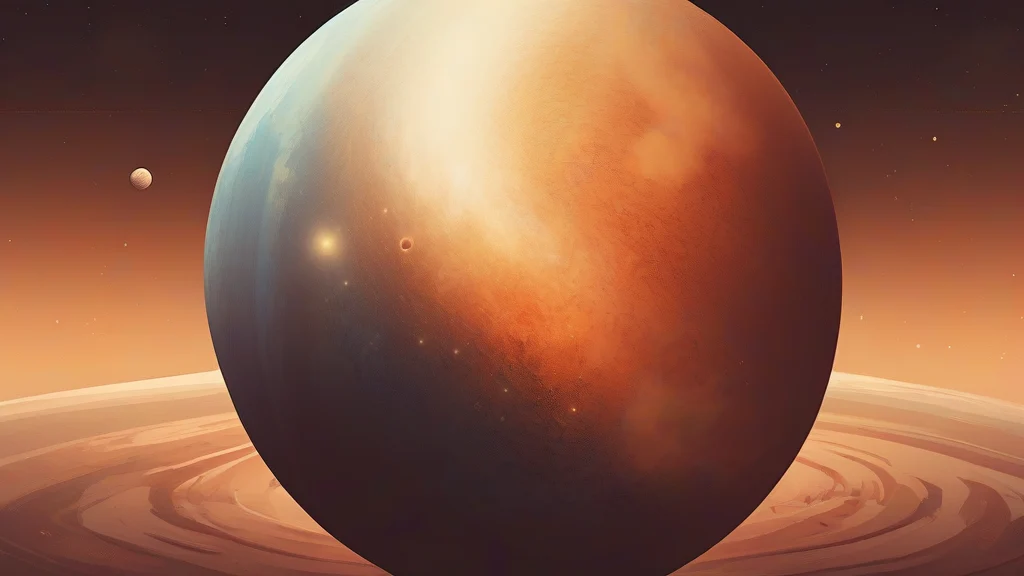
What does planet mean?
A planet is a large body in space that moves around a star in an orbit. Planets do not make their own visible light, so they shine by reflecting light from their star. The Solar System contains eight recognized planets: Mercury, Venus, Earth, Mars, Jupiter, Saturn, Uranus, and Neptune. The word also appears in broader expressions concerning Earth as the world shared by humanity, as in "saving the planet." In astrology, planets are celestial bodies whose positions are interpreted as influences on human affairs. Although the term is often used loosely for various bodies in space, modern astronomy distinguishes planets from dwarf planets, moons, asteroids, comets, and stars. The word's history reflects the appearance of planets as wandering lights: its name derives from the Greek word for "wanderer."
nounA planet is a large, nearly spherical body in space that travels in an orbit around a star and does not produce its own visible light. In the Solar System, the eight recognized planets are Mercury, Venus, Earth, Mars, Jupiter, Saturn, Uranus, and Neptune.
- A large celestial body that orbits a star and does not produce its own visible light.
- The Earth considered as a world inhabited by humanity, especially in the phrase "the planet."
- A celestial body regarded in astrology as having an influence on a person's horoscope.
"Scientists discovered a new planet orbiting a distant star."
"The rover is exploring the surface of Mars, the fourth planet from the Sun."
"The company is committed to reducing its impact on the planet."
"According to astrology, the movement of a planet can affect a person's chart."
The standard plural adds -s; the pronunciation remains unchanged.
"Astronomers have identified thousands of planets outside the Solar System."
The word planet comes from the Greek planētēs, meaning "wanderer," because ancient observers noticed that these points of light wandered among the fixed stars.
Reviewed by Deb Chak, Editor. AI-assisted content curated by RJS Tech Solutions LLP.
Where does planet come from?
The English word planet comes through Latin from Greek planētēs, a "wanderer." The Greek word was related to planasthai, meaning "to wander," and referred to the moving points of light visible against the background of apparently fixed stars. The term entered English in the late Middle English period and was later applied more formally to the non-luminous bodies known to orbit the Sun.
Related word forms
How planet is actually used
In general use, "planet" refers to one of the recognized planets of the Solar System or to a planet outside the Solar System. The definite article is strongly associated with Earth in expressions such as "the planet" and "planet Earth."
Easily confused with planet
A star produces its own light through nuclear fusion, whereas a planet produces no visible light of its own and reflects light from its star.
A world can refer to Earth, a region, or a fictional realm, while a planet is specifically a large body orbiting a star.