
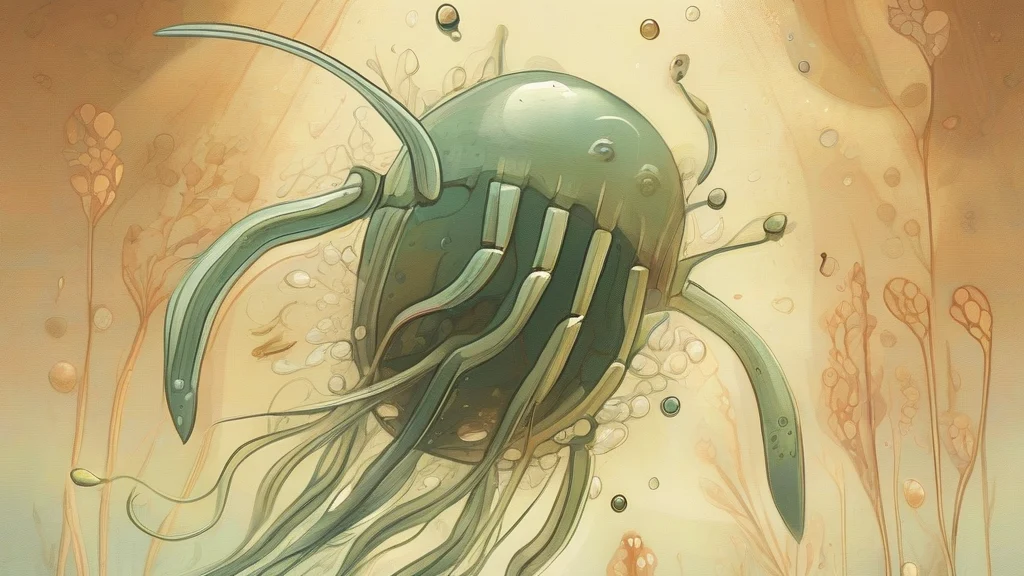
What does plankton mean?
Plankton refers chiefly to the vast collection of organisms that drift with currents in oceans, lakes, and rivers. These organisms are usually too small to see individually and include photosynthetic phytoplankton, such as diatoms and cyanobacteria, as well as animal zooplankton, including small crustaceans and larvae. Although they are mostly microscopic, some planktonic animals can be much larger. Plankton is central to aquatic food webs because many fish and other larger animals feed on it directly or indirectly. The term can denote either the organisms themselves or the collective biological material associated with them. Its use is primarily scientific, but it also appears in environmental reporting, discussions of marine health, and descriptions of phenomena such as plankton blooms. The word’s history reflects the passive movement of these organisms, which are carried by water rather than moving deliberately through it.
nounThe collective term for organisms that drift or are carried through water, especially microscopic organisms such as phytoplankton and zooplankton. The term can also refer to such organisms collectively as a mass of biological material.
- The collective term for organisms that drift or are passively carried through water, especially microscopic plants and animals.
- The biological material or population consisting of these drifting organisms.
"Tiny plankton form the foundation of many marine food webs."
"A dense bloom of plankton transformed the clear water overnight."
"The researchers collected plankton from several depths to study the changing ecosystem."
Normally unchanged in the plural because it is generally used as a collective or mass noun. The form “planktons” is uncommon.
"Plankton are abundant in the coastal waters during the spring."
The word plankton comes from a Greek root meaning “wanderer,” fittingly describing organisms carried by currents rather than swimming actively through the sea.
Reviewed by Deb Chak, Editor. AI-assisted content curated by RJS Tech Solutions LLP.
Etymology of plankton
The word comes from Greek planktos, meaning “wandering” or “drifting,” and plankton was formed in the late 19th century to describe organisms drifting in water. Its scientific sense developed from earlier use of the related term plankton in a biological context. The same Greek root appears in modern derivatives such as planktonic, planktology, and plankter, while the term was adopted internationally as aquatic biology became a distinct scientific discipline.
Related word forms
How plankton is actually used
Plankton is normally used as a collective noun and is usually treated as a mass noun, so it generally takes a singular verb when referring to the assemblage as a whole. Individual members are called plankters. The plural “planktons” is uncommon and is not normally needed.