
What does platypus mean?
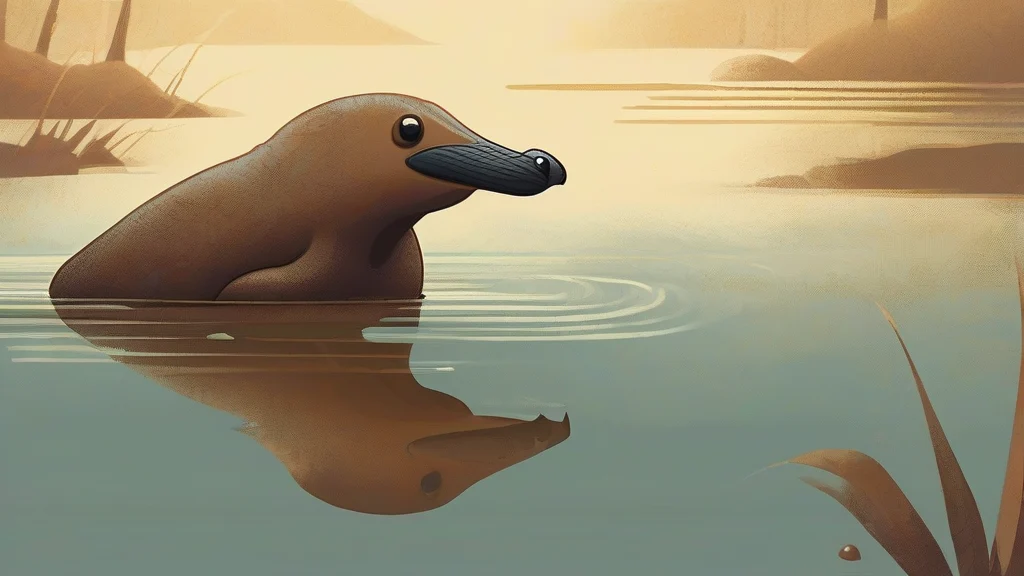
A platypus is a remarkable semi-aquatic mammal native to eastern Australia and Tasmania. It has a broad, flexible, duck-like bill, webbed feet, dense waterproof fur, and a broad, nearly hairless tail that helps it paddle and burrow. Platypuses feed largely on aquatic invertebrates, detecting prey with electroreceptors in the bill. Females lay eggs and later nourish their young with milk, despite having no nipples; the milk seeps through the skin onto an area of the abdomen. Together with echidnas, platypuses form the surviving monotremes, an early branch of mammalian evolution in which egg-laying was retained. The name comes from Greek roots meaning "flat" and "foot." The animal's unusual combination of traits has made it one of the most recognizable and scientifically fascinating mammals.
nounA semi-aquatic, egg-laying mammal native to eastern Australia and Tasmania, with a broad, duck-like bill, webbed feet, and a beaver-like tail. It is the sole living species of its family and one of only five extant monotremes.
- A duck-billed, web-footed, egg-laying mammal native to eastern Australia and Tasmania.
"The platypus swims underwater using its webbed feet and leaves a series of complex burrows along riverbanks."
"Researchers fitted a platypus with a small tracking device before releasing it back into the river."
"The museum display explains how the platypus combines traits associated with mammals, birds, and reptiles."
The standard plural is "platypuses." "Platypus" is unchanged in the singular because its final "s" is part of the name.
"Researchers observed several platypuses foraging in the river."
The platypus is an egg-laying mammal that also produces milk, making it one of evolution's most unusual animal experiments.
Reviewed by Deb Chak, Editor. AI-assisted content curated by RJS Tech Solutions LLP.
Where does platypus come from?
The word comes from New Latin Platypus, adopted from Greek platypus, a term for a broad, flat-footed animal and combining Greek platys, "flat" or "broad," with pous, "foot." The name was used in scientific description before becoming the established English name for the animal. Related English words such as plateau and platitude reflect the same Greek element associated with breadth or flatness.
How platypus is actually used
In standard English, the name refers specifically to the single living species, Ornithorhynchus anatinus. The expression "duck-billed platypus" is a descriptive compound rather than a different name for another species.
Easily confused with platypus
A platypus is a mammal that lays eggs, whereas an octopus is a marine invertebrate with eight arms.
Both have broad, nearly hairless tails, but a platypus is smaller, has a duck-like bill, and lays eggs rather than giving birth to live young.