
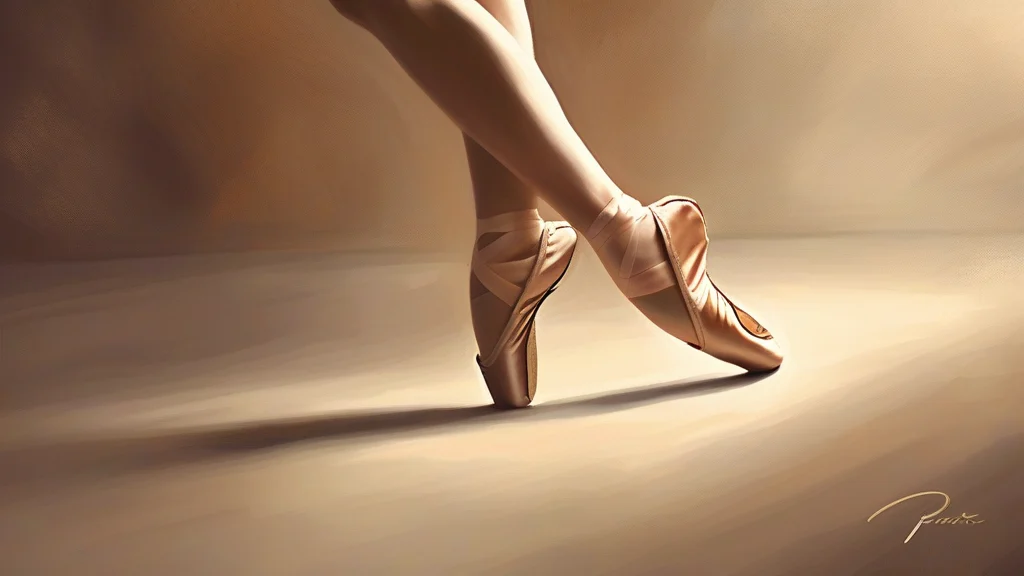
What does pointe mean?
Pointe most often denotes a ballet position in which a dancer supports the body on the tips of the toes. It may also refer to the pointed tips of the toes themselves. Such positions require exceptional balance, strength, and control, and they are commonly enabled by specially constructed pointe shoes, although the shoes assist the dancer rather than create the position. The expression en pointe is the standard way of describing a dancer in this stance. In older and specialized fencing usage, pointe can mean the point of a weapon or a thrust delivered with it. Outside these fields, the word is uncommon, and its use usually signals a technical context such as ballet instruction, dance criticism, or the discussion of fencing. The word ultimately derives from French and Latin words associated with a point or puncture.
nounIn ballet, a position in which a dancer balances on the tips of the toes, or the tips of the toes themselves when supporting the body in that position. In fencing, the word can refer to the point of a weapon or a thrust made with it.
- A ballet position in which the body is supported on the tips of the toes.
- The pointed tips of a dancer's toes when held in that position.
- In fencing, the point of a weapon or a thrust made with it.
"The ballerina sustained a perfect balance en pointe while the orchestra played the final passage."
"She remained en pointe for several bars during the solo."
"The fencer advanced with the blade held in a firm pointe."
The plural is uncommon in ordinary discussion; ballet usage usually treats pointe as a mass noun, as in en pointe and pointe work.
"The ballet included several sustained pointés during the closing variation."
En pointe, a dancer turns the familiar act of standing on tiptoe into a feat of balance, strength, and precision.
Reviewed by Deb Chak, Editor. AI-assisted content curated by RJS Tech Solutions LLP.
Where does pointe come from?
The English word comes from French pointe, the feminine form of point, meaning a point or tip. This in turn continues Latin punctum, a pointed thing, from the Latin verb pungere, meaning to prick or puncture. French and English developed specialized uses of the word in ballet and fencing that reflect its long association with the sharpened or terminal point of something.
How pointe is actually used
Pointe is primarily a technical term in ballet and fencing. In ballet, it is commonly used with the French preposition en, as in en pointe.
Easily confused with pointe
Point is the general word for a tip or position, whereas pointe is chiefly a specialized ballet or fencing term.