
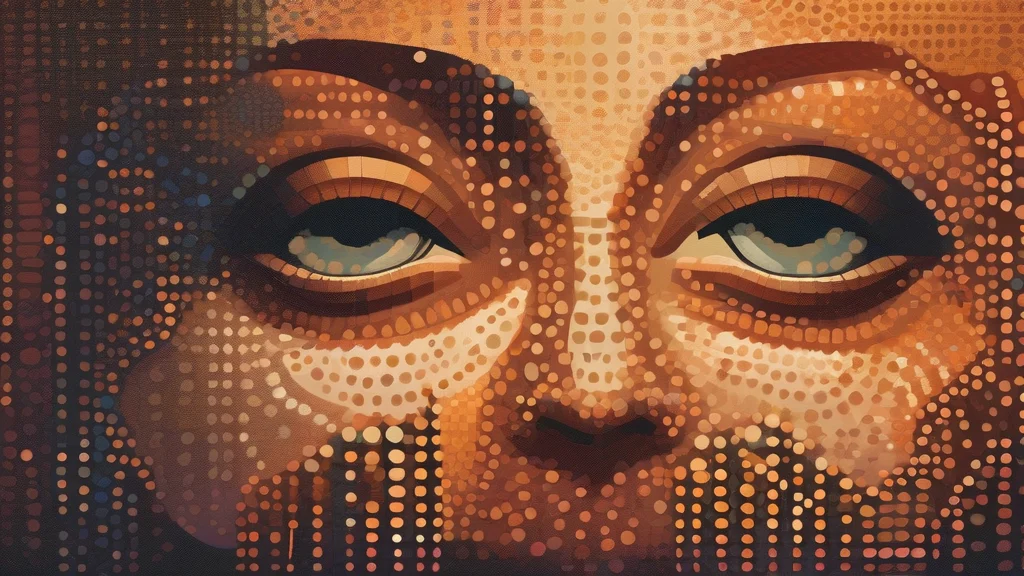
What does pointillism mean?
Pointillism is an artistic technique in which an image is built from many small, distinct dots or touches of color. From a suitable distance, the eye combines these marks into a larger scene, often producing an impression of luminous, vibrating color. The term also refers to the artistic movement associated especially with Georges Seurat and Paul Signac in late-19th-century France, where artists explored systematic color theory and optical mixture. Although sometimes compared with or used interchangeably with divisionism, pointillism more specifically emphasizes the use of discrete dots. Today, the word is used both to describe historical artworks and to discuss modern painting, illustration, and printmaking that deliberately employs a similar mark-making technique.
nounPointillism is a painting technique in which small, distinct dots or strokes of color are applied to a surface so that the image emerges when viewed from a distance. It is also associated with the late-19th-century artistic movement that developed this approach, especially in the work of Georges Seurat and Paul Signac.
- A technique of painting with small, separate dots or strokes of color that visually blend at a distance.
- The late-19th-century artistic movement and style associated with this technique, particularly in the work of Georges Seurat and Paul Signac.
"The painting is an example of pointillism, with countless small touches of contrasting color combining to form a luminous scene."
"The artist used pointillism to create a shimmering harbor scene."
"Pointillism became closely associated with Neo-Impressionism in France during the 1880s."
Pointillism lets the eye mix colors that never literally blend on the canvas, turning tiny dots of paint into shimmering light.
Reviewed by Deb Chak, Editor. AI-assisted content curated by RJS Tech Solutions LLP.
Where does pointillism come from?
Pointillism comes from the English word "point," with the suffix "-ism" forming the name of the technique or movement. The word developed in the late 19th century from the French term "pointillisme," which refers to a style based on small points of color. Its underlying vocabulary ultimately relates to the Latin "punctum," meaning a point or puncture, the same root found in words such as "punctual," "punctuation," and "puncture."
Related word forms
How pointillism is actually used
The term is most often used in art history and criticism. It is usually treated as an uncountable noun, although "pointillism" can also function attributively in phrases such as "pointillism technique."
Easily confused with pointillism
Divisionism is the broader principle of separating color into distinct touches or areas, while pointillism specifically refers to the use of small dots of color.