
What does poleaxe mean?
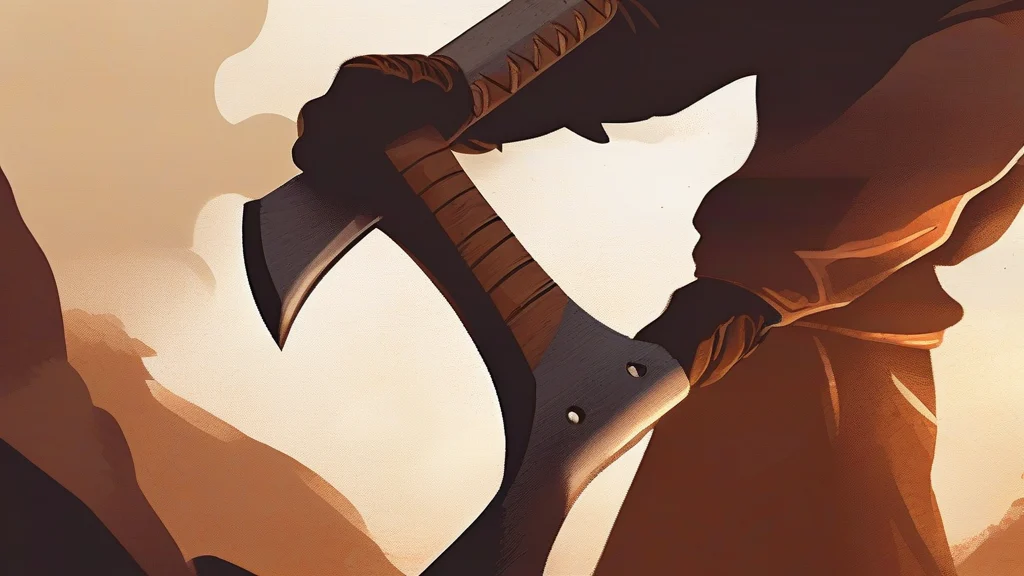
The poleaxe is a long-handled axe associated primarily with medieval and early modern warfare. Its extended shaft allowed an infantry soldier to reach a mounted opponent, while its heavy blade could strike effectively against armor and shields. Poleaxes commonly combined an axe blade with additional projections, such as a spike or hook, making them adaptable weapons rather than ordinary axes. The word is now most often encountered in historical accounts, literature, fantasy, and depictions of period combat. As a verb, "to poleaxe" means to attack or kill someone with such a weapon; this use is uncommon and often carries a violent or dramatic tone. Although it sounds like an archaic survival, the term remains precise and evocative, describing a distinct and recognizable weapon rather than a generic battle-axe.
A long-handled axe used as a weapon in medieval and early modern warfare, often fitted with a spike or hook as well as an axe blade.
"The guard raised his poleaxe to defend the gate from the raiders."
Chiefly historical, but common in literature, historical description, fantasy, and role-playing contexts.
To strike or kill someone with a poleaxe.
"He poleaxed the attacker at the edge of the platform."
This sense is uncommon and usually belongs to dramatic, historical, or archaic-sounding prose.
The standard plural adds "-es"; "pole-axes" is also used with the hyphenated spelling.
"The soldiers carried their poleaxes across the muddy field."
Its long shaft gave an infantry soldier the reach needed to fight a mounted and armored opponent.
Reviewed by Deb Chak, Editor. AI-assisted content curated by RJS Tech Solutions LLP.
Where does poleaxe come from?
The compound "poleaxe" developed in Middle English from "pole" and "axe," with the combined term referring to a long-handled battle-axe. The second element continues Old English "æx," the ancestor of modern "axe" and its shortened variant "ax." Later spelling traditions also produced the forms "pole-axe" and "pollax," while related compounds include "battleaxe."
Related word forms
How poleaxe is actually used
The noun is chiefly historical, though it also appears in descriptions of fantasy, role-playing, and reenactment. The verb is uncommon and usually evokes medieval combat or dramatic violence. The spelling "pole-axe" is also standard.
Easily confused with poleaxe
A poleaxe is a long-handled weapon with an axe-like blade, whereas a pickaxe is a pointed tool designed for breaking hard ground or digging.