
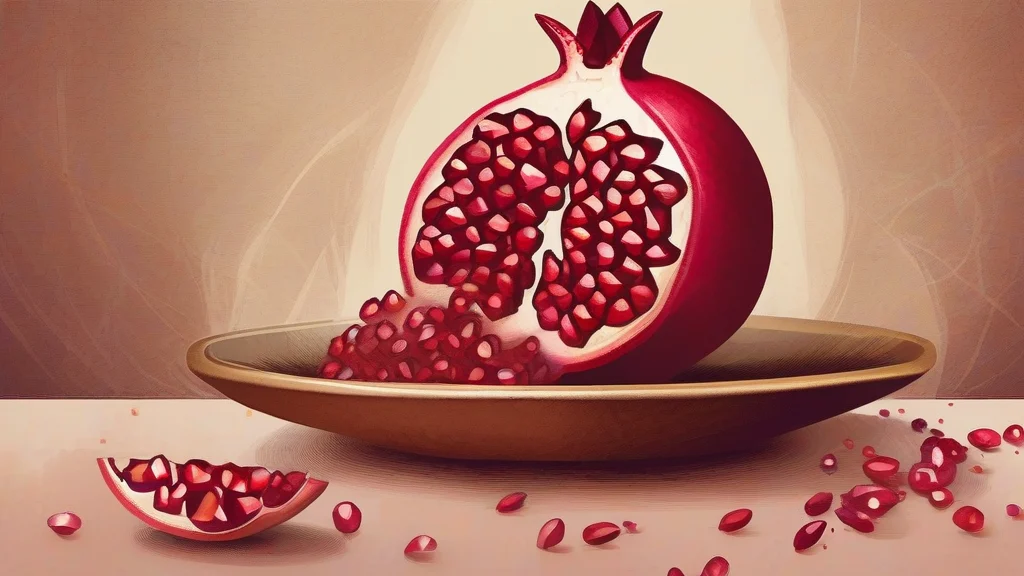
What does pomegranate mean?
A pomegranate is a fruit with a thick, reddish or purple rind and many small, glossy seeds surrounded by juicy, tart flesh. Its distinctive appearance and sweet-tart flavor have made it a familiar ingredient in Middle Eastern, Mediterranean, South Asian, and modern international cooking. The fruit is eaten fresh, pressed for juice, dried for flavoring, and used to garnish salads, rice dishes, desserts, and festive foods. The word can also denote the small deciduous tree that produces it. Pomegranate seeds are botanically called arils, although this technical term is not always needed in ordinary usage. The fruit has a long history in cultivation and has become especially popular in modern cuisine for its bright color, concentrated flavor, and possible health-promoting reputation. Its name reflects the appearance of a many-seeded fruit, while its close association with the garnet also gives the mineral its name.
The fruit of a deciduous tree, having a leathery red, purple, or yellowish rind and many edible seeds within.
"Pomegranate molasses adds a sharp sweetness to the sauce."
When used for culinary purposes, the term may refer specifically to the edible arils, or seeds, rather than the entire fruit.
A deciduous tree that produces pomegranates, with showy red-orange flowers and thorny branches.
"They planted a pomegranate in the sheltered courtyard."
The standard plural is “pomegranates,” used for multiple fruits, trees, or individual items relating to the fruit.
"The market was stacked with pomegranates in autumn."
Pomegranate means roughly “apple of many seeds,” a fitting name for a fruit packed with hundreds of jewel-like arils.
Reviewed by Deb Chak, Editor. AI-assisted content curated by RJS Tech Solutions LLP.
Where does pomegranate come from?
The English word entered through Old French and Medieval Latin forms of pomegranate, ultimately combining Latin pomum, meaning “apple,” with granatum, meaning “seeded” or “having many seeds.” The name therefore describes the fruit as an “apple of many seeds.” The familiar association between the fruit’s deep red color and the similarly colored mineral garnet is also reflected in the latter word’s history.
How pomegranate is actually used
The word is standard in British and American English. In culinary contexts, “pomegranate” usually refers to the edible seeds rather than the surrounding leathery rind; the seeds are botanically arils.
Easily confused with pomegranate
A pomegranate is a fruit and its tree, whereas a garnet is a mineral commonly used in jewelry.