
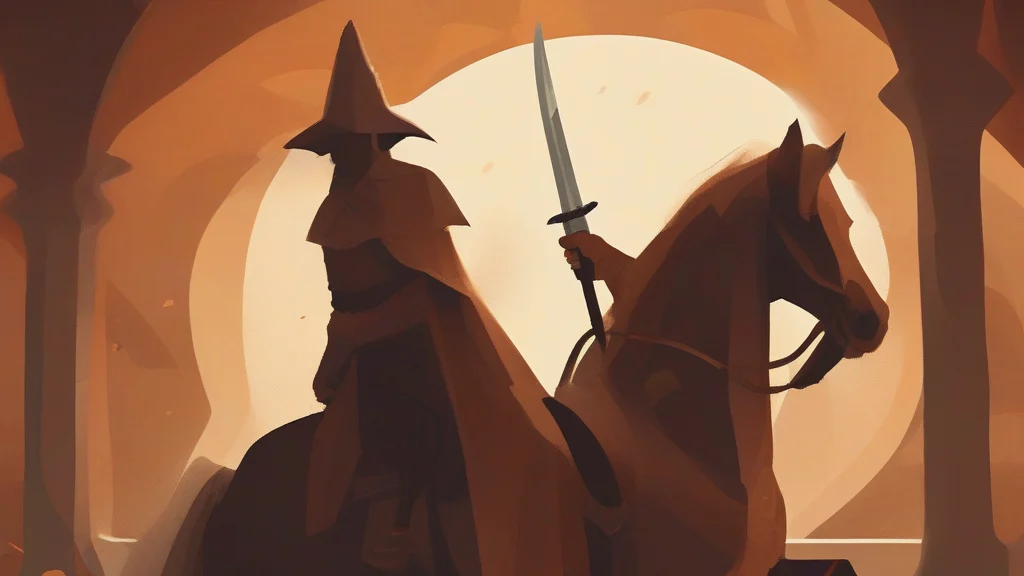
What does poniard mean?
A poniard is a small dagger with a narrow, pointed blade, especially one intended for thrusting rather than cutting. The word occurs chiefly in historical accounts, literature, and other dramatic writing, where it evokes secrecy, treachery, or sudden violence. Although a poniard can simply be described as a dagger, its form makes the weapon particularly suitable for piercing armor, clothing, or a human body. The related verb means to stab with a poniard and is now largely literary or archaic. In modern writing, the word is most likely to appear when a writer wants to specify a discreet, thrusting weapon or to evoke a scene of intrigue and danger. Its uncommon character gives it a dramatic quality that the broader term dagger does not necessarily convey.
A small, narrow-bladed dagger designed primarily for thrusting rather than slashing.
"The assassin tested the point of the poniard before concealing it in his sleeve."
Now uncommon; chiefly used in historical, literary, or dramatic contexts.
To stab someone with a poniard.
"The villain poniarded his opponent before the guards could intervene."
Rare and literary; often implies a treacherous or violent act.
The usual plural of the noun; the inflection poniarded belongs to the verb and is not used as a noun plural.
"Several poniards were displayed beside the ceremonial armor."
A poniard is built to puncture, not slash: its narrow point favors a sudden thrust over a broad cut.
Reviewed by Deb Chak, Editor. AI-assisted content curated by RJS Tech Solutions LLP.
Where does poniard come from?
The word entered English in the early 17th century from French poignard, a dagger or small sword. French poignard developed from an element meaning a sharp point or the act of stabbing, ultimately associated with the Latin pugnus, meaning fist. The same Latin root lies behind related words such as pugnacious, pugilist, and impugn.
Related word forms
How poniard is actually used
Poniard is uncommon in contemporary prose and is chiefly found in historical, literary, or dramatic contexts. The verb is still more archaic and often carries a sense of treachery or violent betrayal.
Easily confused with poniard
A poniard is generally a small thrusting dagger, whereas a stiletto is distinguished by its particularly long, slender, sharply pointed blade.
A dirk is a dagger and may have a broad, cutting blade, while a poniard characteristically has a narrow blade intended for piercing.