
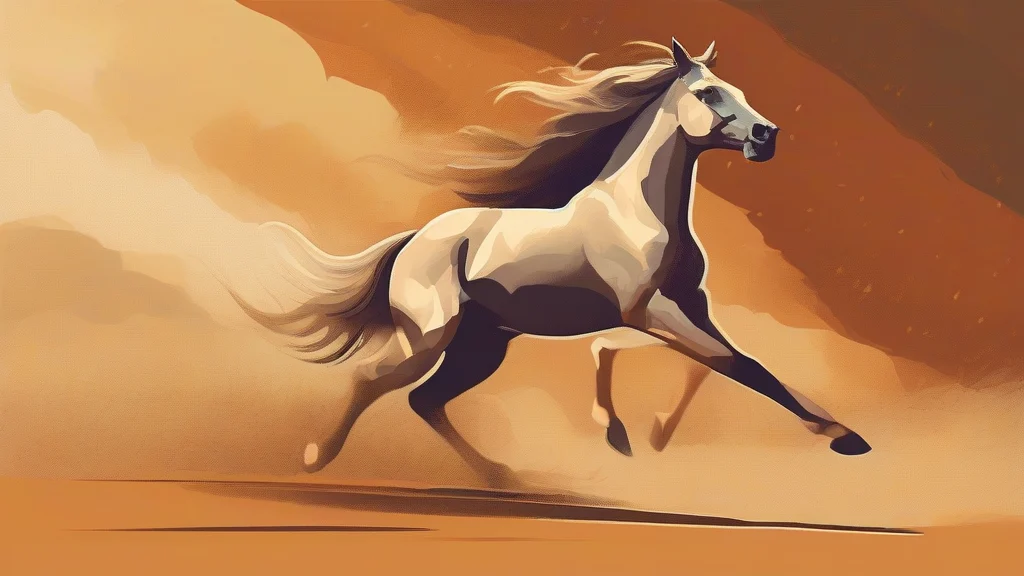
What does prancing mean?
Prancing means moving with high, springing steps, usually in a proud, lively, or showy way. The word is especially familiar from descriptions of horses that lift their forelegs and move with energetic, elegant strides, but it can also refer to people behaving with theatrical excitement or conspicuous self-display. “Prancing around” often suggests playful eagerness, while the description of a person or performance as prancing can carry a mildly critical note that the movement is excessive or affected. As the present participle of prance, the word works both as a verb form—“the horse is prancing”—and as an adjective—“a prancing stallion.” It is vivid because it conveys more than ordinary walking or running: the movement is elevated, springy, and often performative. The word is understood in both British and American English and is useful whenever an author wants to suggest proud, exuberant, or showy movement.
To move with high, springing steps, especially in a proud, lively, or showy manner.
"The colt began to prance as soon as it entered the arena."
The verb can describe both animals and people; when applied to people, it often suggests conspicuous excitement or showiness.
Characterized by high, springing, energetic, or showy movement.
"The prancing pony delighted the children watching from the fence."
This adjectival use is the present participle of prance functioning as a descriptive participle.
Prancing turns movement into performance: it evokes a high-stepping display that is proud, playful, or deliberately showy.
Reviewed by Deb Chak, Editor. AI-assisted content curated by RJS Tech Solutions LLP.
Where does prancing come from?
Prancing comes from the English verb prance, which is recorded in Middle English and is commonly traced to an Anglo-French form associated with gamboling or dancing. The verb's deeper origin is uncertain, though it is sometimes linked with prank, in the older sense of moving or walking with swagger. The related noun prancer denotes a horse or person that prances, while prankster developed from the more general lineage of prank.
Related word forms
How prancing is actually used
Prancing is common for the movement of horses and for people moving with conspicuous excitement or self-display. It can be admiring or gently derisive, especially when someone is described as prancing around rather than doing something purposeful.
Easily confused with prancing
Prance is the base verb, while prancing is its present-participle form, as in “the horse is prancing.”