
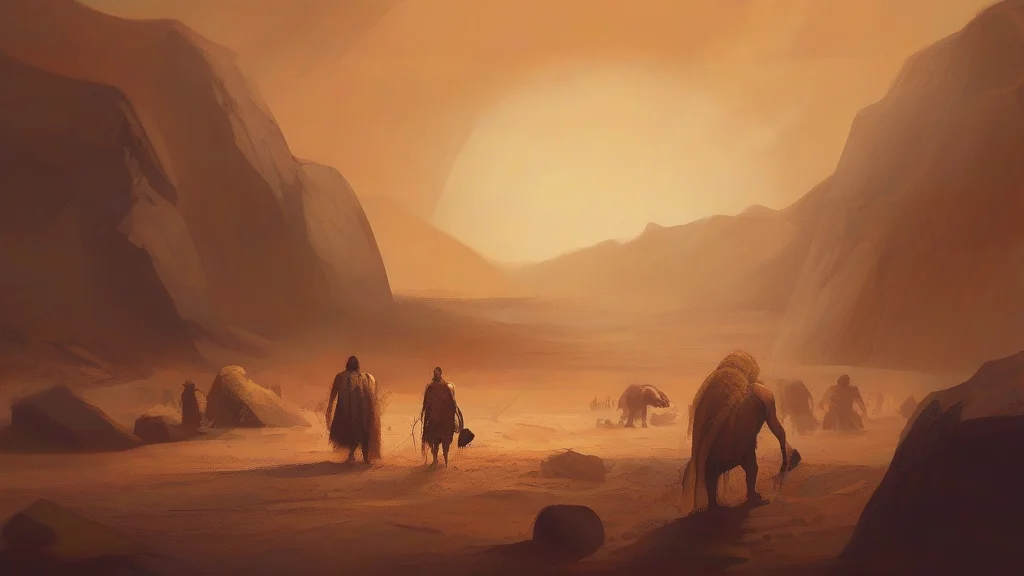
What does prehistory mean?
Prehistory is the vast span of human existence before the invention of writing and the keeping of written records. Because no documents survive from this time, our knowledge of it comes from archaeology, geology, genetics, and the study of artefacts such as tools, bones, and cave paintings. The word also names the discipline concerned with this period. Prehistory is not a single fixed stretch of time, since writing appeared at different moments in different places. In Mesopotamia prehistory ended around five thousand years ago, while in some regions it lasted until recent centuries. The term carries a neutral, scholarly tone, though it can also be used figuratively for the early, formative stages of a later development, as in the prehistory of an idea or an institution. It is a useful word because it reminds us that the written record covers only a small fraction of the human story, and that most of our past can be read only through physical evidence.
nounThe period of human existence before the invention of writing and the keeping of written records. It also means the study of that period, and the earlier stages in the development of something.
- The period of human life before written records existed.
- The academic study of that period, usually through archaeology.
- The early stages or background of an idea, event, or situation, before it became established.
"Cave paintings offer a rare glimpse into the prehistory of the continent, long before any written language took hold."
"Archaeologists piece together the prehistory of the region from pottery fragments and stone tools."
"The prehistory of the modern computer stretches back to mechanical looms and calculating engines."
Rare, since the word is normally uncountable. The plural appears when comparing the separate prehistories of different regions or cultures.
"The book compares the distinct prehistories of Africa, Asia, and the Americas."
Prehistory covers roughly 99 percent of human existence, because writing is only about five thousand years old.
Reviewed by Deb Chak, Editor. AI-assisted content curated by RJS Tech Solutions LLP.
Where does prehistory come from?
Prehistory is formed in English from the prefix pre-, from Latin prae meaning before, and history. History comes via Latin historia from Greek historia, meaning inquiry or knowledge gained by investigation. The adjective prehistoric appeared in the 19th century, and the noun prehistory followed it in the same period as archaeology developed into a scientific discipline.
Related word forms
How prehistory is actually used
Formal and academic in register, and neutral in tone. It is normally uncountable and takes no article when it refers to the whole period. In the figurative sense, it points to an earlier phase that shaped something later, as in the prehistory of a movement. Different regions assign very different end dates to prehistory, depending on when writing first appeared there.
Easily confused with prehistory
Prehistory is a noun naming the period before written records, while prehistoric is the adjective describing things belonging to that period.