
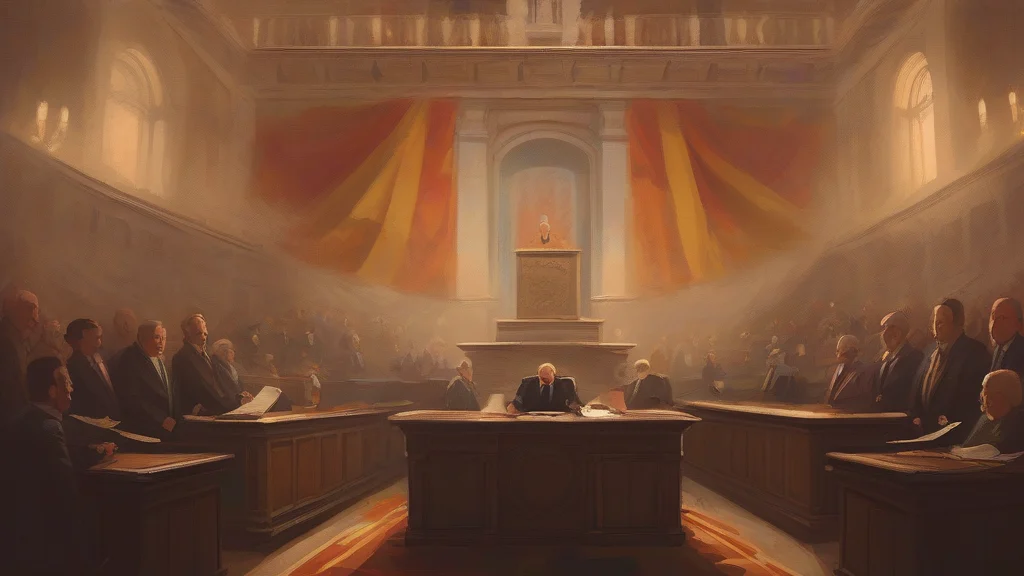
What does prorogation mean?
Prorogation is the formal postponement or conclusion of a session of a legislature, most famously the British Parliament. In this parliamentary sense, it can end the period in which Parliament meets without dissolving the institution itself, a distinction that has occasionally made prorogation the subject of political and constitutional controversy. More generally, the word refers to postponement or deferral, though this broader sense is much less common. Prorogation is usually associated with legal, governmental, and institutional language rather than ordinary conversation. It is closely related to the verb “prorogue,” which means to postpone or formally conclude such a session. The word is sometimes confused with “prolongation,” but prolongation means extending the duration of something, whereas prorogation refers specifically to a formal deferral or the ending of a legislative session.
nounThe formal postponement or ending of a session of a legislature, especially the British Parliament. The term can also refer more generally to the act of deferring an action or event.
- The formal postponement or conclusion of a session of a legislature, especially Parliament.
- The act of postponing or deferring an action, event, or decision.
"The committee criticized the government's decision to seek the prorogation of Parliament."
"The prorogation of Parliament allowed the government to postpone a contentious vote."
"The organization's annual meeting was delayed by the prorogation of the event until the following spring."
The plural is used when referring to separate formal postponements or instances of prorogation, usually of legislative sessions.
"The political crisis led to several prorogations and repeated delays."
In the United Kingdom, prorogation can end a parliamentary session without dissolving Parliament itself—a distinction that has made the word a focus of constitutional controversy.
Reviewed by Deb Chak, Editor. AI-assisted content curated by RJS Tech Solutions LLP.
Where does prorogation come from?
Prorogation comes through Latin from prorogare, meaning “to postpone” or “put off,” formed from the prefix pro- and rogare, “to ask.” The English word entered use in the early modern period in legal and parliamentary contexts. Related forms include the verb “prorogue,” while “rogation” and “abrogate” reflect the same Latin root of asking or proposing, although their modern meanings are different.
How prorogation is actually used
The word is formal and especially common in legal and parliamentary contexts. In British usage, prorogation formally ends a parliamentary session but does not necessarily end the Parliament itself; it differs from an adjournment, which is usually a temporary break, and from dissolution, which ends the parliamentary term.
Easily confused with prorogation
Prorogation formally postpones or concludes a legislative session, whereas prolongation means extending the duration of something.