
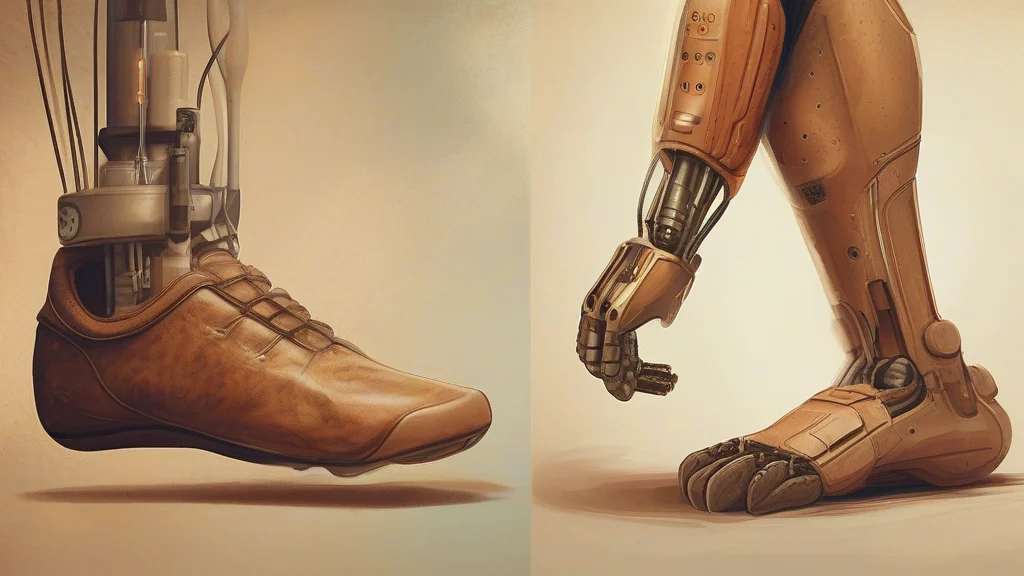
What does prosthetic mean?
A prosthetic is an artificial device that replaces, supports, or augments a part of the body. The most familiar examples are prosthetic arms, legs, and joints, although the term can also describe devices that restore hearing, speech, vision, or other functions. As an adjective, “prosthetic” describes such devices, procedures, or forms of rehabilitation: for example, prosthetic dentistry concerns the replacement and repair of teeth, while prosthetic surgery uses implants to restore or improve bodily function. The word is primarily associated with medicine, engineering, and rehabilitation, but it is also common in discussions of accessibility, disability, and assistive technology. Its use carries a generally neutral connotation, emphasizing the practical relationship between a person and an artificial replacement. Although “prosthetic” is sometimes used loosely when “prosthesis” would be more precise, the distinction is useful in specialist and technical writing because it allows the noun to name a device and the adjective to describe anything connected with prosthetic work.
An artificial device that replaces, supports, or augments a part of the body or restores a bodily function.
"The prosthetic was specially fitted to match the shape of the injured leg."
In technical writing, “prosthesis” is often preferred when referring specifically to the artificial device itself.
Relating to an artificial replacement or augmentation of a body part or bodily function.
"Her prosthetic arm allows her to lift objects with considerable precision."
Common in medical, technical, and rehabilitation contexts.
The plural commonly refers to artificial devices collectively or to the branch of medicine concerned with making and fitting them.
"The specialist in prosthetics works with patients who have lost limbs or require joint replacements."
The word prosthetic comes from the Greek for “fitted on,” an apt description of a device designed to replace or support a missing body part.
Reviewed by Deb Chak, Editor. AI-assisted content curated by RJS Tech Solutions LLP.
Where does prosthetic come from?
The word comes from Greek prosthētikos, meaning “fitted for putting on” or “adapted,” which derives from prosthētos, “put forward” or “fitted on.” The medical term “prosthesis” was formed from the related Greek noun prosthesis, meaning “an addition” or “something put on.” English adopted the medical sense of an artificial body part in the 19th century, and “prosthetic” developed alongside it in referring to replacement or augmentation of bodily functions.
Related word forms
How prosthetic is actually used
The noun is usually used in medical and technical contexts. In general usage, “prosthetic” may refer broadly to an artificial replacement or to surgery involving an implant, as in “prosthetic surgery.”
Easily confused with prosthetic
A prosthesis is the artificial body part or device itself, whereas a prosthetic is either that device considered as a noun or an adjective relating to such devices.