
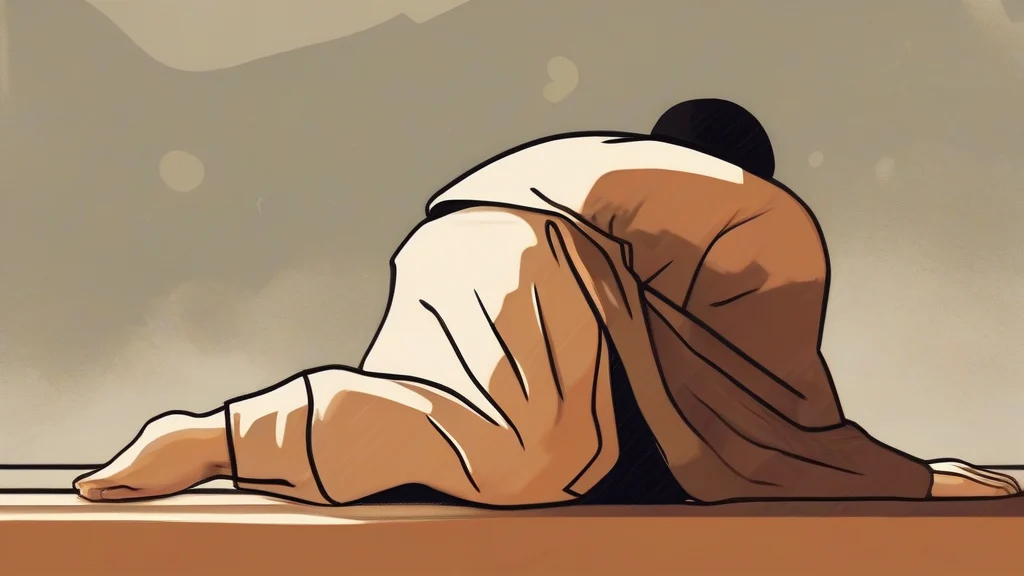
What does prostration mean?
Prostration is the act of bowing down or lying prone as an expression of submission, respect, worship, or surrender. In historical and religious contexts, it can denote a formal ritual in which a person lowers their entire body before a ruler, deity, or sacred object. The word also describes extreme physical weakness, exhaustion, or emotional collapse, as when someone is described as being in a state of prostration after distressing news. Its associations are consequently twofold: outwardly, it suggests humility and the surrender of status or autonomy; inwardly, it can suggest helplessness and the temporary disabling of ordinary powers. Prostration is more formal and emphatic than a simple bow or genuflection. In figurative use, it conveys severity more strongly than words such as upset or distressed, often implying that a person has been psychologically or physically overwhelmed.
nounAn act of lying or bowing down in homage, submission, or worship. It can also refer to a state of extreme physical weakness or emotional distress.
- An act of bowing or lying down in homage, submission, or worship.
- A condition of extreme physical weakness, exhaustion, or emotional collapse.
"The envoy's prostration before the monarch was understood as a formal sign of allegiance."
"With a final bow, the petitioner lowered himself in prostration before the assembled elders."
"She was left in a state of emotional prostration after receiving the news."
The plural is uncommon because prostration is usually used as an uncountable noun; the plural occurs mainly when separate acts of submission or collapse are being discussed.
"The crowd's repeated prostrations filled the courtyard with solemn silence."
From the Latin for being thrown down, prostration has transformed acts of complete submission into expressions of worship, respect, fear, or exhaustion.
Reviewed by Deb Chak, Editor. AI-assisted content curated by RJS Tech Solutions LLP.
Where does prostration come from?
The word entered Middle English from Latin, where prostratio meant a bowing down or a throwing down. Latin prosternere, the source of prostratio, combined the prefix pro- with sternere, meaning to lay down, and the related forms prostratus and prostrate also developed from this root. English cognates such as substratum and superstratum ultimately trace to the same Latin verb, while prostrate and its inflected forms are direct English derivatives of prostration's Latin ancestor.
Related word forms
How prostration is actually used
In the sense of homage or worship, prostration often carries a formal, historical, or religious tone. Its figurative use for emotional or physical collapse is common in literary and journalistic writing.
Easily confused with prostration
Prostration is the act or condition of bowing down or lying low, whereas prostrate is primarily an adjective describing someone lying face down or overcome with weakness.