
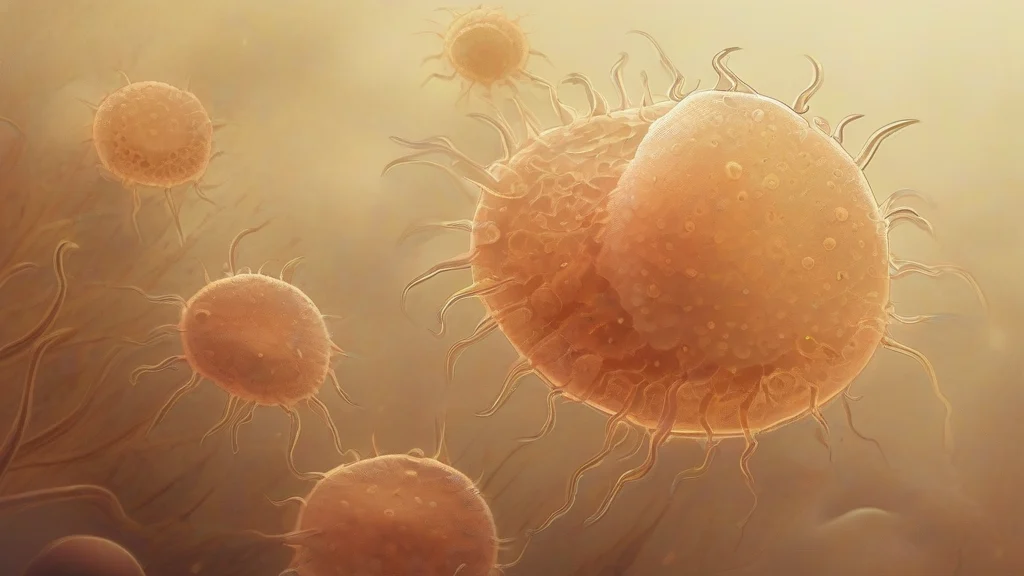
What does protozoan mean?
A protozoan is a single-celled eukaryotic organism, especially one that moves actively and was historically regarded as an animal-like microorganism. Examples include amoebas, paramecia, and many flagellated forms. The word is often used in biological and medical contexts, particularly when describing protozoan parasites and the infections they cause. Although their simple, one-celled organization once encouraged the traditional description of protozoans as “the first animals,” modern biology places them among the eukaryotes rather than within the animal kingdom. The term remains useful as a general category for discussing these organisms, while modern classifications may prefer more specific names or the broader term protist. Protozoans can move through water using cilia, flagella, or temporary cellular extensions, and many obtain food by engulfing particles or absorbing dissolved nutrients.
nounA protozoan is a single-celled eukaryotic organism, traditionally regarded as animal-like because of its movement or food-catching behaviour. The group includes organisms such as amoebas, paramecia, and many flagellates.
- A single-celled eukaryotic organism, especially one capable of movement and traditionally classified as an animal-like protist.
"A protozoan can move independently through water using cilia, flagella, or temporary extensions of its cell."
"Researchers examined the protozoan under a microscope after collecting it from pond water."
"The parasite is a protozoan that can cause severe illness in humans and other animals."
Protozoans is the standard plural of protozoan. Protozoa is also common and is the traditional plural associated with protozoon.
"Several protozoans were visible in the sample."
The name means “first animal”: protozoans were once described as the simplest animals, even though modern biology classifies them as eukaryotes rather than members of the animal kingdom.
Reviewed by Deb Chak, Editor. AI-assisted content curated by RJS Tech Solutions LLP.
Where does protozoan come from?
The word comes from Greek prōtos, meaning “first,” and zōon, meaning “animal.” It was developed from the related term protozoon and reflects the historical view of these organisms as primitive, single-celled animals. The same Greek root zōon also underlies words such as zoology and zoo.
Related word forms
How protozoan is actually used
The term is chiefly used in biology and medicine. In everyday use it is less common than the names of particular protozoans, such as amoeba or paramecium.
Easily confused with protozoan
A protozoan is a single-celled eukaryote with a nucleus and membrane-bound organelles, whereas a prokaryote such as a bacterium lacks a membrane-bound nucleus.
A protozoan is traditionally an animal-like member of the protists, while protist is a broader term that can include organisms with plant-like or fungus-like characteristics.