
What does pulley mean?
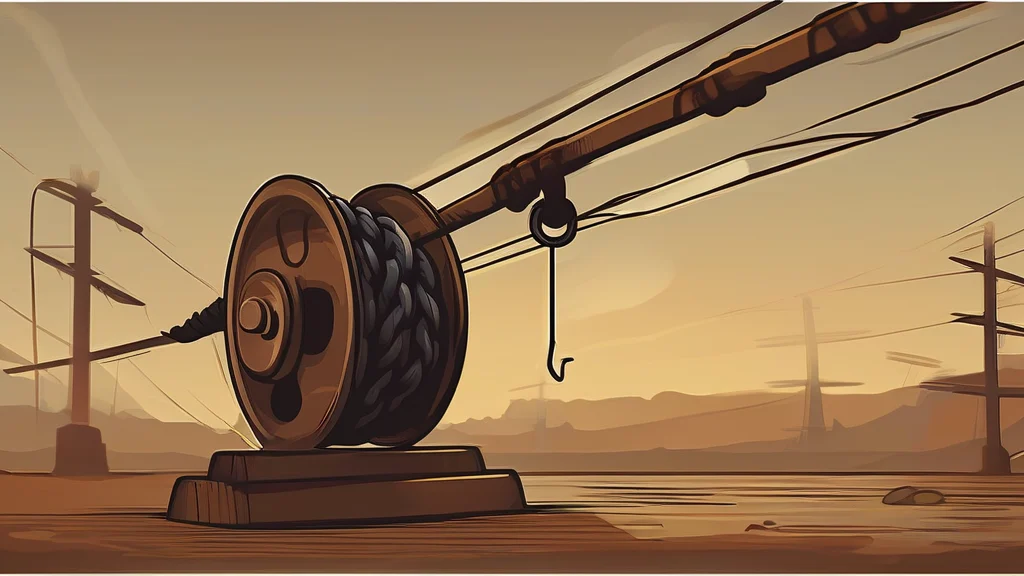
A pulley is a simple but useful machine consisting of a grooved wheel over which a rope, cable, or belt passes. By changing the direction of a pull, it can make lifting and hauling easier; in a larger system, several pulleys can provide mechanical advantage, allowing a person to move a load that would otherwise be difficult to raise. Pulleys appear in cranes, elevators, sailing equipment, gym machinery, stage systems, and many other mechanisms. The word commonly refers to an individual grooved wheel, though it can also be used for a complete pulley arrangement. In British and American English, its pronunciation is essentially the same: /ˈpʊli/. Pulley is also occasionally used as a verb, especially in older or more literary writing, meaning to raise or move something using a pulley. The word is memorable not merely because of its engineering usefulness, but because it illustrates how a small change in the path of a force can make a heavy task manageable.
A grooved wheel with a rope, cable, or belt running over it, used to change the direction of a pull or transmit mechanical force; by extension, a pulley system or lifting mechanism.
"The crane operator adjusted the pulley before lifting the load."
Usually countable. In British and American English, the word is standard in both everyday and technical descriptions of machinery.
To raise, lower, or move something by means of a pulley.
"The crew pulleied the supplies up to the deck."
Uncommon and somewhat literary or historical; the standard past-tense and participial form is pulleied.
The standard plural is pulleys.
"The engine drives several pulleys in the belt system."
A pulley turns an awkward lift into a manageable pull: the harder you work, the more the wheel can help.
Reviewed by Deb Chak, Editor. AI-assisted content curated by RJS Tech Solutions LLP.
Where does pulley come from?
The English word pulley entered Middle English from Old French poulie, which came through Medieval Latin pulleus. The ultimate origin of the Latin term is uncertain, although it is generally treated as having been transmitted through medieval European usage. The word has close Romance cognates, including French poulie, Spanish polea, Italian puleggia, and Portuguese roldana, all referring to a wheel-and-rope lifting device.
How pulley is actually used
As a noun, pulley is common in technical, nautical, engineering, and everyday mechanical contexts. It is normally countable, and the plural pulleys is standard. The verb is much less common and sounds formal, literary, or historical; pulleied is the usual past-tense form.