
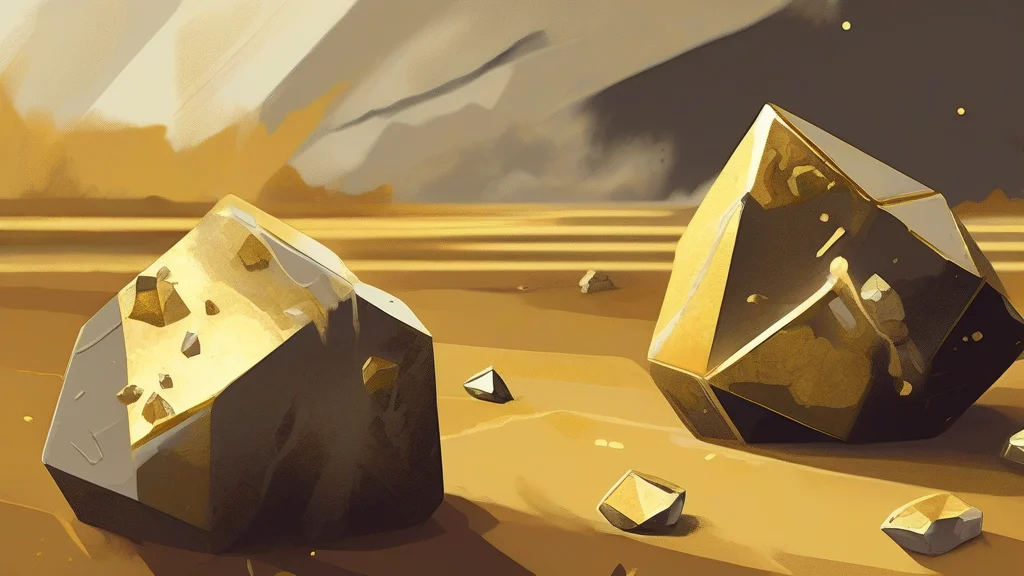
What does pyrite mean?
Pyrite is a mineral made chiefly of iron disulfide, with the chemical formula FeS2. It typically appears as pale brass-yellow, metallic-looking crystals, masses, or granular deposits and is commonly known as fool's gold because its appearance can resemble valuable gold. The word is especially useful in geology, mining, mineralogy, and chemistry, where identifying pyrite helps distinguish a common sulfide mineral from actual precious metal ore. Pyrite can also occur as a replacement mineral, vein material, or accessory mineral in sedimentary and metamorphic rocks. Although pyrite may be familiar through the phrase fool's gold, the technical noun refers to a specific mineral rather than to any glittering substance. In everyday figurative use, fool's gold can describe an attractive but deceptive prospect or promise, extending the mineral's association with appearance versus reality.
nounPyrite is a mineral composed of iron disulfide, commonly occurring as brassy yellow crystals or granular masses. It is often called fool's gold because its metallic appearance can resemble native gold, although it contains no gold.
- A brassy, opaque iron sulfide mineral with the chemical formula FeS2, often forming cubic crystals or granular masses and commonly known as fool's gold.
"The museum display features a cluster of pyrite crystals from a sulfur-rich geological formation."
"A polished piece of pyrite reflects the light with an unexpectedly bright metallic sheen."
"The geologist identified the black band as pyrite rather than gold."
Pyrite is usually singular when referring to the specific mineral. Pyrites can function as a related plural, but in mineralogy it may also denote a broader group of sulfide minerals.
"The specimen contains bright pyrites embedded in quartz."
Pyrite forms glittering, golden crystals that earned it the nickname fool's gold, but it is not gold: its chemical formula is FeS2.
Reviewed by Deb Chak, Editor. AI-assisted content curated by RJS Tech Solutions LLP.
Where does pyrite come from?
The English word pyrite entered use in the early 17th century from the Latin pyrites. Latin had borrowed the term from Greek pyritēs, a word associated with pyr, meaning fire, reflecting pyrite's historical association with sparks when struck and with the production of sulfur. The Greek fire root is also preserved in English cognates such as pyre, pyrexia, pyrogenic, and pyromania.
Related word forms
How pyrite is actually used
Pyrite is generally used in the singular when referring to the mineral, with pyrites serving as a related plural or broader mineral term. The nickname fool's gold is often used figuratively for something impressive but deceptive. In technical writing, pyrite is more precise than the broader term pyrites.
Easily confused with pyrite
Pyrite names the specific iron disulfide mineral, while pyrites can refer to pyrite in some contexts or more broadly to certain sulfide minerals.