
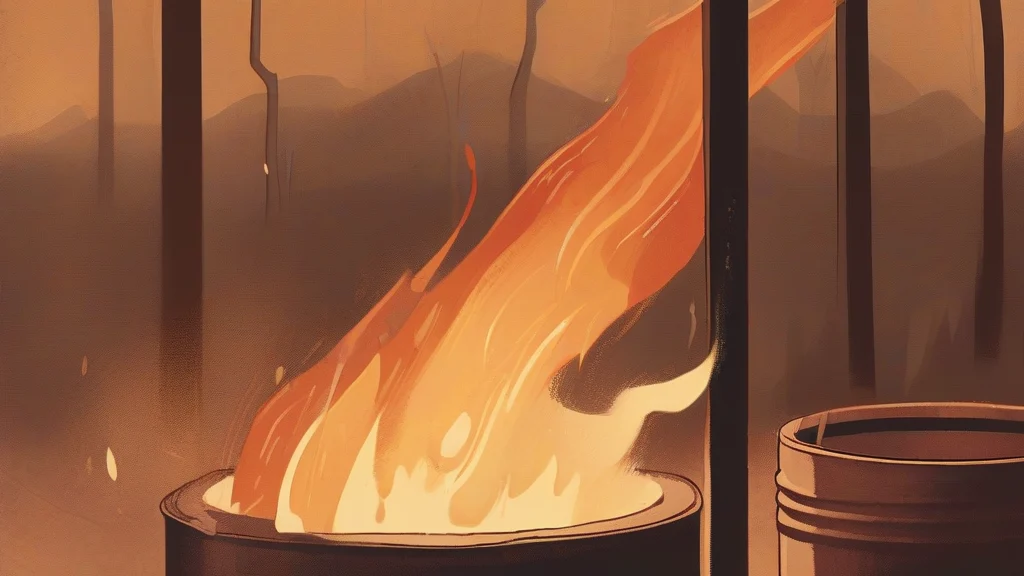
What does quenched mean?
Quenched is the past tense and past participle of quench, and it is also used as a participial adjective. Its central idea is the stopping or settling of something: a fire can be quenched, thirst can be quenched, and hot metal can be quenched by rapid cooling. The word therefore extends metaphorically from putting out flames to satisfying a bodily need and calming intense emotion. In metallurgy, quenching has a specific technical meaning: heating a metal and then cooling it quickly in a liquid to alter properties such as hardness. Quenched can describe the result, as in “quenched steel” or “her quenched thirst.” Its tone is formal or literary when used for emotions or desires, while ordinary and technical in firefighting and materials science. Unlike a simple synonym such as cooled, quenched suggests deliberate intervention, a decisive stopping, or a rapid change of state.
To extinguish a fire or flame, satisfy thirst or another need, cool metal rapidly, or metaphorically subdue an emotion or disturbance.
"The timely rain quenched the flames threatening the crops."
The form is both the past tense and the past participle of quench.
Described as extinguished, cooled, satisfied, or subdued, especially in participial constructions.
"With her thirst quenched, she returned to the meeting."
Commonly used before a noun, as in “quenched steel,” or after a subject, as in “metal quenched in oil.”
A blade’s strength can come from a shock: heating it and plunging it into liquid to cool it rapidly is metal quenching.
Reviewed by Deb Chak, Editor. AI-assisted content curated by RJS Tech Solutions LLP.
Where does quenched come from?
The word descends from Old English cwenc, meaning “to extinguish, put out, or suppress,” and developed through Middle English forms such as quenchen and quenchen. The Old English root also produced the archaic asquench, meaning to extinguish or suppress. Quench is of Germanic origin and has relatives in languages such as Dutch and German; the modern form is standard in both British and American English.
Related word forms
How quenched is actually used
The word has a formal or literary tone when used figuratively for emotions and desires. In technical contexts, especially metallurgy, it has a precise meaning involving rapid cooling.
Easily confused with quenched
Quench is the base verb, while quenched is its past tense and past participle or an adjective describing the result of quenching.