
What does reed mean?
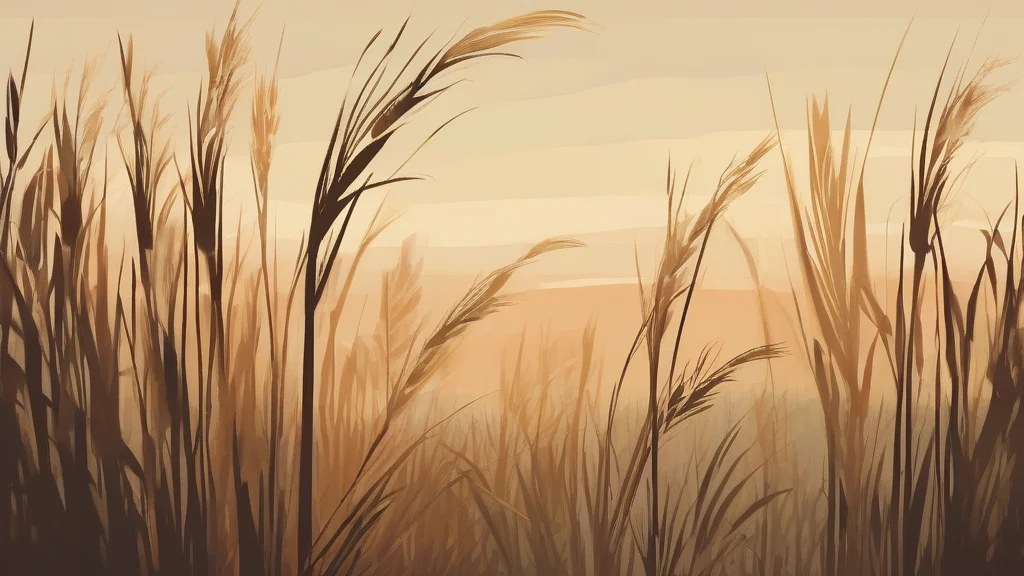
A reed is most commonly a tall grass-like plant that grows beside rivers, lakes, and marshes. Its hollow stalks have long been used for pipes, baskets, roofing, and other objects. In music, the word also refers to a thin elastic strip that vibrates when air is blown across it, producing the tone of instruments such as clarinets, saxophones, and bagpipes; the term can additionally mean the mouthpiece containing that strip. A related technical sense describes a flexible contact inside certain electrical switches. The word appears in familiar expressions including “reed bed,” meaning an area thickly covered with reeds, and “reed instrument,” meaning a wind instrument whose sound is generated by a vibrating reed. Because reeds are associated with wetlands and windblown vegetation, they are also common subjects in descriptions of natural landscapes. The word’s historical development is closely tied to the plant and to the use of its hollow stems as pipes.
nounA tall perennial plant of the grass family, commonly found in damp ground or by water and bearing hollow stalks. The word also denotes the elastic vibrating strip in a wind instrument, the mouthpiece containing such a strip, and a similar contact used in some electrical switches.
- A tall, narrow-leaved plant of the grass family, usually growing in damp soil or shallow water.
- The hollow stalk of such a plant, especially when used as material.
- A thin, elastic strip that vibrates to produce sound in a woodwind or reed instrument.
- The mouthpiece of a wind instrument, fitted with a vibrating strip.
- A flexible metal contact used to open or close an electrical circuit in certain switches.
"Tall reeds grew along the riverbank, stirring in the summer wind."
"A pair of swans glided through the reeds at dusk."
"The musician replaced the damaged reed before beginning the piece."
"The radio operator pressed the reed switch and waited for a response."
Use “reeds” for multiple stalks or plants, or collectively for an area densely covered by the plants.
"The reeds bent beneath the weight of the flock of migrating birds."
From a wetland plant to the sound of an oboe: a single reed has carried music on the wind for millennia.
Reviewed by Deb Chak, Editor. AI-assisted content curated by RJS Tech Solutions LLP.
Where does reed come from?
The word comes from Old English rēod, referring to the tall waterside grass and its stalk. It is generally traced to a Germanic root associated with the plant’s upright form or color. The musical sense developed from the practice of making pipes from the plant’s hollow stems, while the later electrical sense arose from the resemblance between a metal reed and the vibrating strip used in musical instruments.
Related word forms
How reed is actually used
In musical terminology, the sense is chiefly associated with reed instruments such as clarinets, saxophones, and bagpipes. As an adjective in “reedy voice,” it describes a thin, high-pitched, or unsteady vocal quality.
Easily confused with reed
A reed is a grass-like plant or a vibrating strip in an instrument, whereas to read is to interpret written words.
A reed can be a hollow plant stalk or the vibrating part of a wind instrument, while lead is a heavy metal or a guide.