
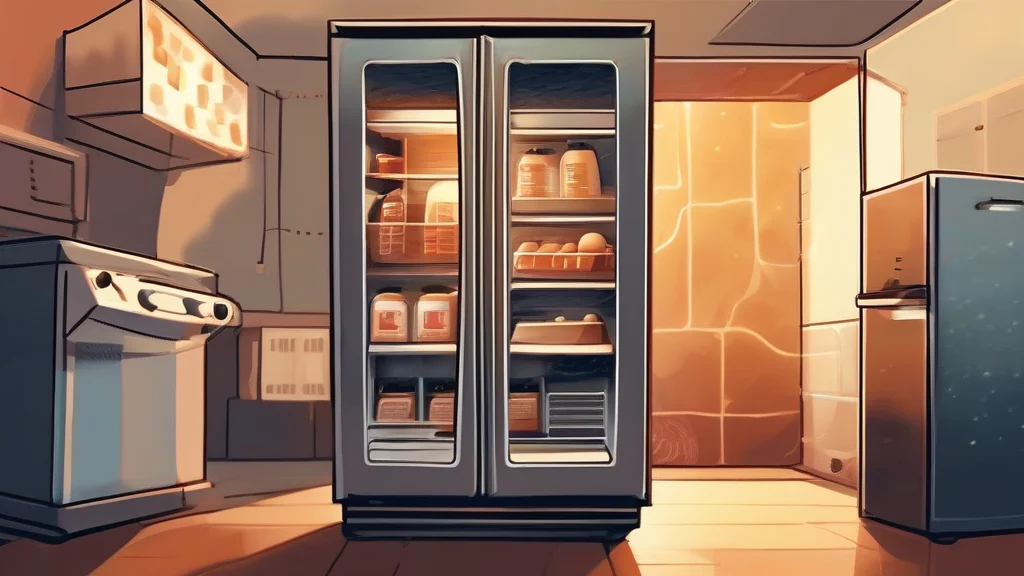
What does refrigeration mean?
Refrigeration is the controlled cooling of a space, substance, or product and the preservation of perishable goods through that process. The term is used especially in food storage, transport, medicine, commerce, and industry. A refrigeration system removes heat from an enclosed area or maintains a substance at a prescribed low temperature, slowing spoilage and the growth of many microorganisms. It also describes the wider use of cooling equipment for maintaining safe and stable conditions. In everyday language, refrigeration often implies keeping food and medicines cold, while in engineering and logistics it can refer to the complete process and infrastructure of cooling. The word is closely related to refrigerate, refrigerator, and refrigerant, and is distinct from the appliance itself: a refrigerator performs refrigeration, but refrigeration can also occur in ships, warehouses, vehicles, and specialized industrial facilities.
nounThe process of making something cold or keeping it at a low temperature, especially in a controlled environment. It is also used for the use of refrigerating equipment to preserve food and other perishable products.
- The process of cooling something or maintaining it at a low temperature.
- The use of cooling equipment to preserve food and other perishable materials.
- A cooling or refrigerating system, especially in a commercial or industrial setting.
"Cold-chain refrigeration is essential for keeping vaccines at a safe temperature during transport."
"The refrigeration system in the warehouse is powered by an emergency generator."
"The fruit is grown in a climate that allows it to be shipped without refrigeration for several days."
Plural forms are uncommon; the word is normally used in the singular or as a mass noun.
"The design features separate refrigeration systems for each storage area."
Refrigeration transformed food storage, helped slow the spread of disease, and made modern cities possible.
Reviewed by Deb Chak, Editor. AI-assisted content curated by RJS Tech Solutions LLP.
Etymology of refrigeration
Refrigeration comes from refrigerate, which was borrowed from French réfrigérer and ultimately from Latin refrigerare, a compound of re- “again” and frigerare “to cool.” The underlying Latin root frigus means “cold.” The family later produced forms including refrigerator, refrigerant, and refrigerated, and the terminology expanded as mechanical cooling became central to food preservation and transport.
Related word forms
How refrigeration is actually used
Refrigeration is common in technical, commercial, scientific, and regulatory contexts. It usually refers to controlled cooling rather than simply making something feel cool.
Easily confused with refrigeration
Refrigeration is the process of cooling or preserving something, whereas a refrigerator is the appliance or chamber used to carry out that process.
Refrigeration generally involves cooling a defined space or substance, while air-conditioning controls the temperature and often the humidity of indoor air.