
What does rhubarb mean?
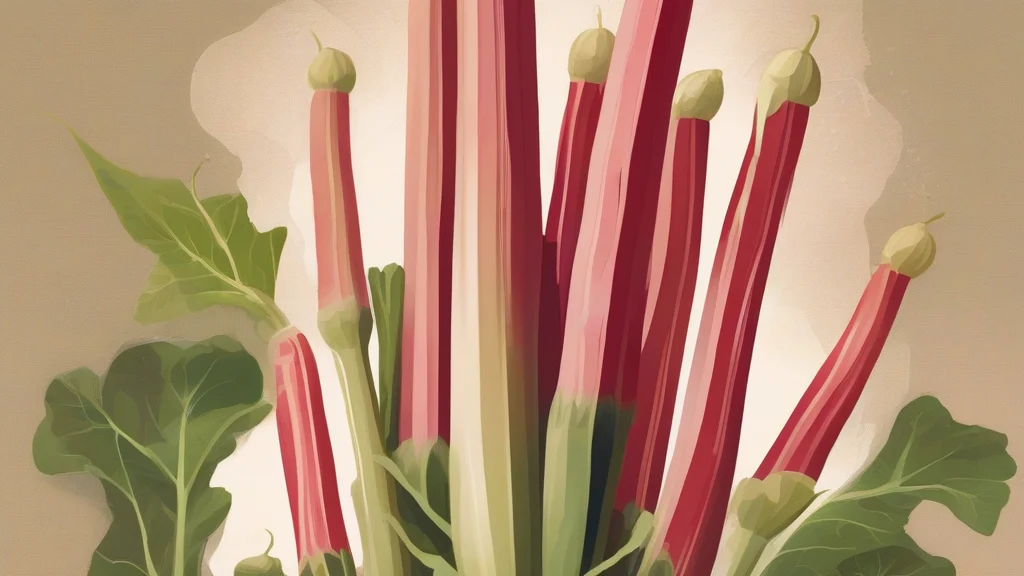
Rhubarb is a hardy perennial plant grown for its thick leaf stalks, which have a tart flavor and a distinctive pink or red color. Although the plant resembles a large-leaved garden weed, its edible stalks are commonly cooked with sugar in pies, crumbles, compotes, and preserves. The raw stalks are generally too sour to eat comfortably, and their tartness is associated with naturally occurring malic acid. The word can also function as an adjective describing the plant's characteristic reddish-pink color. In British informal English, rhubarb is also a verb: to “rhubarb” means to talk at length, often in a repetitive or unintelligible manner. This use is chiefly dismissive, suggesting that someone's speech lacks substance. In culinary contexts, rhubarb ordinarily denotes the edible stalk rather than the leaves, which are not used as food.
A large-leaved perennial plant, or its thick edible leaf stalk, used as a tart ingredient in pies, crumbles, and preserves.
"We added chopped rhubarb to the batter for the tart."
The food is usually treated as an uncountable mass noun, though rhubarbs is occasionally used for individual plants.
Denoting the reddish-pink color characteristic of rhubarb stalks.
"The walls were painted a dusty rhubarb shade."
This attributive use is common in descriptions of paint, textiles, and interior colors.
To talk or chatter at length, especially in a rambling, repetitive, or nonsensical way.
"They spent the whole afternoon rhubarring about nothing."
Chiefly British and informal; it is often used dismissively.
Usually unnecessary when referring to the edible stalks or the crop as a whole, but valid for counting individual plants in formal or botanical contexts.
"Several large rhubarbs grew along the edge of the garden."
Rhubarb looks like a celery stalk but brings the bracing tartness of malic acid to pies, sauces, and crumbles.
Reviewed by Deb Chak, Editor. AI-assisted content curated by RJS Tech Solutions LLP.
Where does rhubarb come from?
English rhubarb entered through medieval Latin as a name for the Asian plant used medicinally and for coloring. The word derives ultimately from a Persian form, usually transliterated as rubarb, transmitted through European medical and commercial usage. The modern culinary sense became firmly established in Britain, where the cultivated plant became especially associated with pies and forced winter production.
How rhubarb is actually used
As a food, rhubarb is normally treated as an uncountable mass noun; individual edible pieces are called stalks. As a color term, it may be used attributively, as in “rhubarb pink.” The verb is informal and chiefly British, where it can imply aimless, repetitive, or tedious talk.