
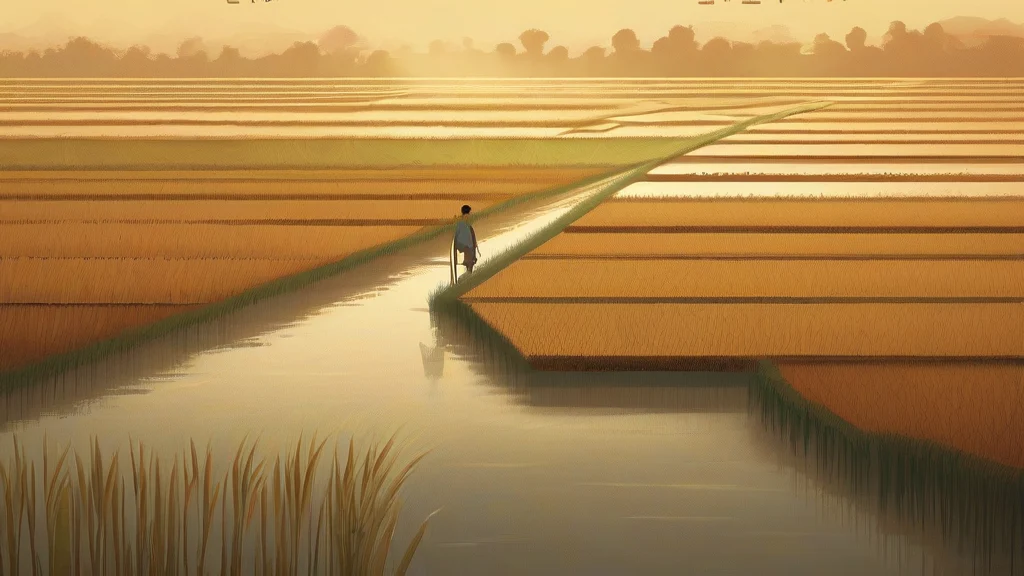
What does ricefield mean?
A ricefield is an area of land where rice is grown, usually one that is irrigated or flooded so that the crop can develop in saturated soil. In everyday English, the phrase is more often written as two words, “rice field,” while the closed form “ricefield” is widely used in agricultural, geographic, and environmental writing. The word can refer to a single cultivated plot or, more broadly, to an entire tract or region devoted to rice production. Ricefields are often managed with bunds, channels, and controlled water levels, making them significant features of wetland agriculture as well as major sources of staple food. The term is especially common in descriptions of South and Southeast Asian landscapes, where flooded rice cultivation has long been central to rural communities and local economies. It can also appear in discussions of soil salinity, water use, flooding, and changes to traditional farming systems.
nounA field or area of land planted with rice, often one that is flooded or irrigated during cultivation. The term is commonly written as “rice field” in general English and as “ricefield” in technical, geographic, and agricultural contexts.
- A field or area of land planted with rice.
- A tract of land cultivated for rice, especially in a region where wet-rice farming is traditional.
"The village is surrounded by ricefields that flood during the rainy season."
"Workers transplanted seedlings across the ricefield shortly after sunrise."
"The report described changes in irrigation and water management across the region’s ricefields."
The regular plural is “ricefields”; when written as two words, it is “rice fields.”
"The valley contains ricefields of several different sizes."
A ricefield is not simply a field with rice in it: it is a carefully managed mini-landscape, often flooded, irrigated, and bounded to control water.
Reviewed by Deb Chak, Editor. AI-assisted content curated by RJS Tech Solutions LLP.
Where does ricefield come from?
“Ricefield” is a modern compound formed from “rice” and “field.” “Rice” entered English through Old French ris, from the Italian riso, ultimately deriving from Greek oryza; “field” comes from Old English feld, inherited from Germanic roots. The compound is especially associated with the cultivation of rice in Asia, where irrigated and flooded fields are characteristic agricultural landscapes.
Related word forms
How ricefield is actually used
“Rice field” is the more usual spelling in everyday English; “ricefield” is common in agricultural, geographical, and technical writing. In British English, “paddy” may refer to a flooded individual plot, while “ricefield” can describe a larger area containing several plots.
Easily confused with ricefield
A paddy is specifically a flooded or waterlogged plot used for growing rice, whereas a ricefield may refer more broadly to any field in which rice is cultivated.