
What does rick mean?
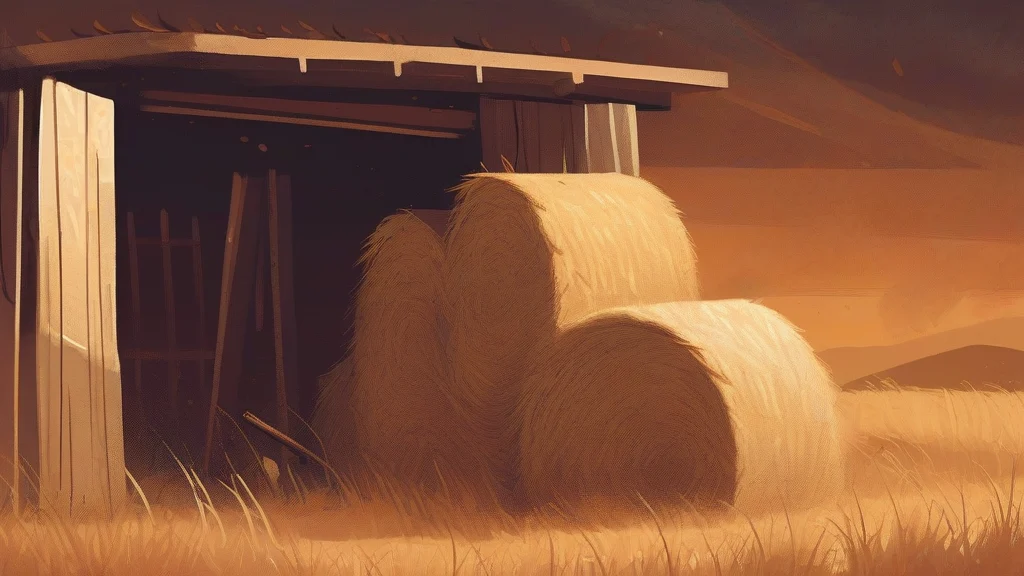
A rick is a traditional stack or pile of harvested material, most commonly hay, straw, or corn. Before the widespread use of bales and enclosed storage, such stacks were commonly built in fields and barnyards, making the word a reminder of older agricultural practices. In the United States and Britain, it remains associated especially with rural vocabulary, although its frequency has declined. The word can also mean a trick or deception, but that sense is now largely obsolete. As a verb, rick means to twist or contort, often the neck or another part of the body. In this use, it can suggest a sudden, strained movement, as when someone awkwardly turns to see or reach something. Although less common than general words such as stack, pile, or twist, rick has a distinctive historical and rural character that makes it useful in descriptions of traditional farming, landscape, and older forms of storage.
A stack or pile of hay, straw, corn, or similar material; in an obsolete sense, a trick or deception.
"A rick of golden corn stood at the edge of the field."
The agricultural sense is chiefly traditional and rural. The sense meaning deception is obsolete.
To twist or contort, especially the neck or body.
"The horse ricked its neck sharply to avoid the low branch."
Used mainly in British and American English, with a somewhat literary or traditional tone.
The plural is used when referring to multiple stacks or piles of material.
"Several ricks of hay stood beside the field."
Before haystacks became compact bales, grain and fodder were traditionally stored outdoors in tall stacks called ricks.
Reviewed by Deb Chak, Editor. AI-assisted content curated by RJS Tech Solutions LLP.
Where does rick come from?
The noun comes from Old English hrēac, meaning a stack or pile, particularly of hay or grain. It continued in Middle English as rik before developing into its modern form. The separate verb meaning to twist or contort comes from Middle English rekken, which is related to forms expressing twisting or wrenching in other Germanic languages.
How rick is actually used
The noun is traditional rural usage, especially in Britain and parts of North America. The sense meaning deception is now obsolete. The verb has a somewhat literary tone and often describes a sharp or painful twisting of the neck or body.