
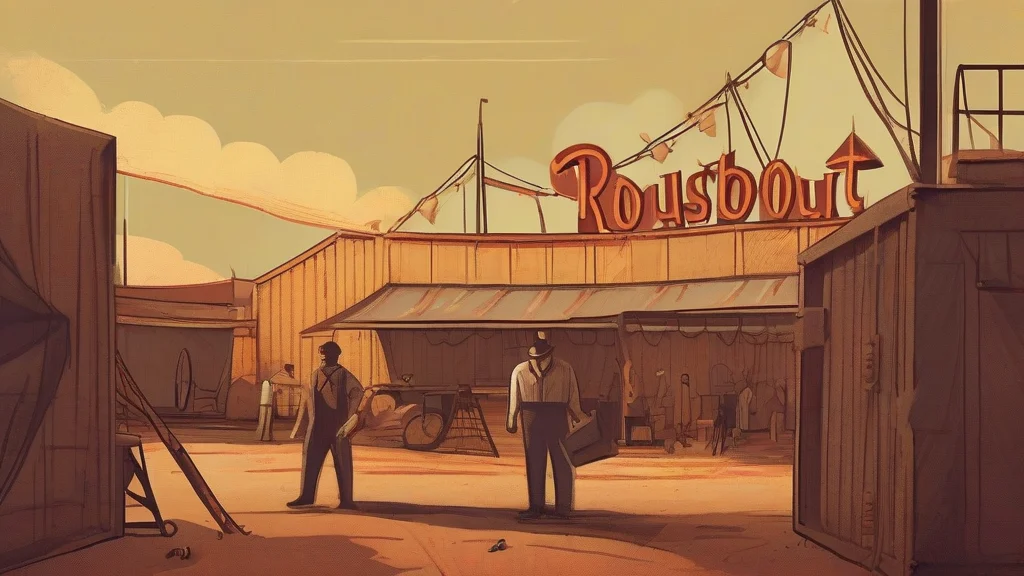
What does roustabout mean?
A roustabout is an unskilled worker who performs practical, heavy, or menial tasks. The term is particularly associated with docks, warehouses, industrial sites, and circuses, where temporary or general laborers move equipment and materials, clean working areas, and assist with whatever jobs arise. Its modern connotation is often occupational and mildly dismissive, and it may sound old-fashioned in general conversation. Although the word can describe someone who is merely an assistant or handyman, it usually implies manual work and a relatively subordinate position. In its second, broader sense, a roustabout is someone available for whatever practical task needs doing, rather than someone trained for a particular trade. The word is most useful when discussing labor in settings where workers are organized around physical tasks rather than specialized skills.
An unskilled laborer who performs heavy or menial work, especially at a port, industrial site, circus, or similar workplace.
"The roustabouts lifted the heavy crates onto the truck."
Often used in occupational or historical contexts and sometimes carries a dismissive or old-fashioned tone.
A person who undertakes whatever practical or temporary work is needed.
"He traveled with the troupe as a roustabout, handling equipment and assisting the performers."
This broader sense is especially common in circus and itinerant-work contexts.
The regular plural is used for both the occupational and broader senses.
"Several roustabouts were hired to prepare the site before the event."
From a word meaning to push or haul, “roustabout” originally described a worker who moved heavy goods around a waterfront.
Reviewed by Deb Chak, Editor. AI-assisted content curated by RJS Tech Solutions LLP.
Where does roustabout come from?
The word combines a form of “roust,” related to pushing or hauling heavy objects, with “about,” giving an early sense of someone who moves things about. Its development is associated especially with waterfront labor, where workers hauled goods and equipment. The first element is related to “rout” and, more distantly, to words such as “route” and “router,” reflecting a history of movement and conveyance.
How roustabout is actually used
The word is somewhat old-fashioned and can sound dismissive when used about a person, so it is more appropriate in occupational or historical contexts than in casual description. It is especially associated with waterfront and circus work.