
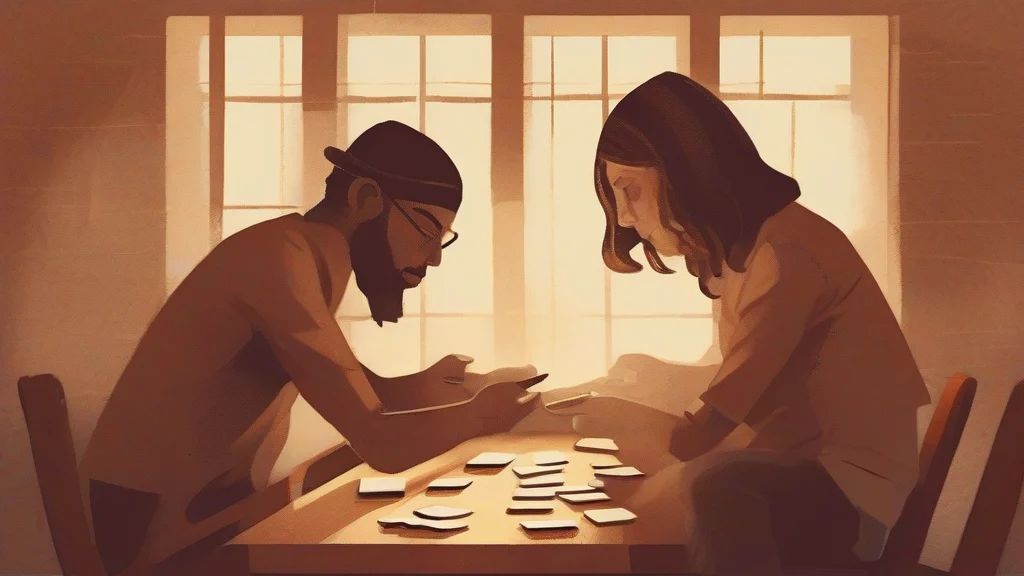
What does shuffle mean?
To shuffle is to rearrange something so that its order becomes unpredictable or different from before. The most familiar use is with cards or a deck: a player shuffles the cards to mix them before dealing. More broadly, “shuffle” describes moving people or objects into a new arrangement, usually with small, repeated movements. Figuratively, it can mean avoiding or evading a responsibility, such as when someone shuffles off a difficult task. The word is informal to neutral in most modern contexts, although the card-related sense is also used in technical descriptions of probability and computer algorithms. As a noun, a “shuffle” is an act of rearranging or mixing, or a sound or movement suggestive of shuffling. It is common in British and American English and is especially useful when describing the deliberate randomization involved in games, sorting, and chance.
To rearrange cards or other items into a different, usually random, order.
"The dealer shuffled the cards and asked the players to take their seats."
The card sense is standard and widely understood. The verb also describes moving someone or something into a new position, and figuratively avoiding or evading an issue or responsibility.
An act of rearranging or mixing something, especially cards; a sound or movement resembling such an act.
"Give the deck a thorough shuffle before the game begins."
As a noun, “shuffle” usually refers to the action of mixing or rearranging cards.
The plural is used for separate acts of shuffling.
"The performers practiced a series of quick shuffles across the stage."
Shuffling cards is one of the oldest forms of randomization: it gives every card an equal chance of being the next one dealt.
Reviewed by Deb Chak, Editor. AI-assisted content curated by RJS Tech Solutions LLP.
Where does shuffle come from?
The word appears in Middle English, where it was associated with moving or mixing items and, in time, with rearranging playing cards. Its precise origin is uncertain, so it should not be confidently assigned a particular ancient root. The modern sense developed naturally from the idea of shifting objects back and forth and losing their original order.
Related word forms
How shuffle is actually used
The verb is standard in both British and American English. In its figurative sense, “shuffle” can mean to avoid dealing with a difficult issue or person, often in the phrase “shuffle off responsibility.”