
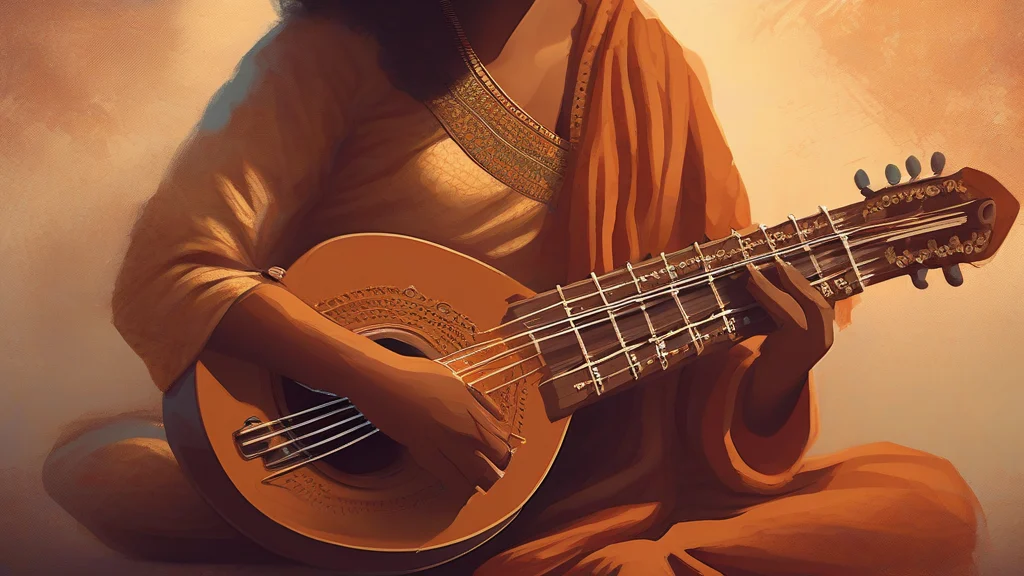
What does sitar mean?
A sitar is a plucked stringed instrument from northern India, best known for its long neck, movable metal frets, and rounded gourd-shaped body. It produces a distinctive, often ringing sound and may have sympathetic strings that continue to resonate after the main strings are plucked. The instrument is used in classical, devotional, and popular music, both as a solo instrument and in accompaniment for singers. It is sometimes confused with the guitar because both are plucked stringed instruments, but their construction and sound differ considerably. The English word came through Hindi from Persian and refers to an earlier three-string form of the instrument. Its characteristic frets allow performers to bend notes continuously, producing the glissandos and vocal-like timbres for which the sitar is especially famous.
nounA plucked stringed instrument of Indian origin with a long neck and a variable number of movable metal frets. It is especially associated with northern Indian classical and devotional music.
- A plucked Indian stringed instrument with a long fretted neck and a gourd-shaped resonating body.
"The musician accompanied the vocalist on a sitar."
"She has studied sitar since childhood."
"A sitar player performed an improvised passage during the concert."
The regular plural is sitars.
"The collection includes several sitars made by noted instrument builders."
The sitar earned its name from Persian for “three-stringed,” a reference to one of its traditional forms.
Reviewed by Deb Chak, Editor. AI-assisted content curated by RJS Tech Solutions LLP.
Where does sitar come from?
The English word sitar was borrowed through Hindi from Persian سیتار (sitār). The Persian name is commonly derived from سهتار (seh-tār), literally “three-stringed.” The instrument entered wider English use in the early nineteenth century, when it became associated with music and performance traditions from northern India.
How sitar is actually used
The word is standard in both British and American English. It is sometimes used more broadly for similar Indian plucked instruments, though a sitar specifically has movable metal frets and a characteristic gourd body.
Easily confused with sitar
A sitar has a long neck with movable metal frets and a smaller resonating body, whereas a guitar generally has a wider hollow body and frets fixed to the neck.