
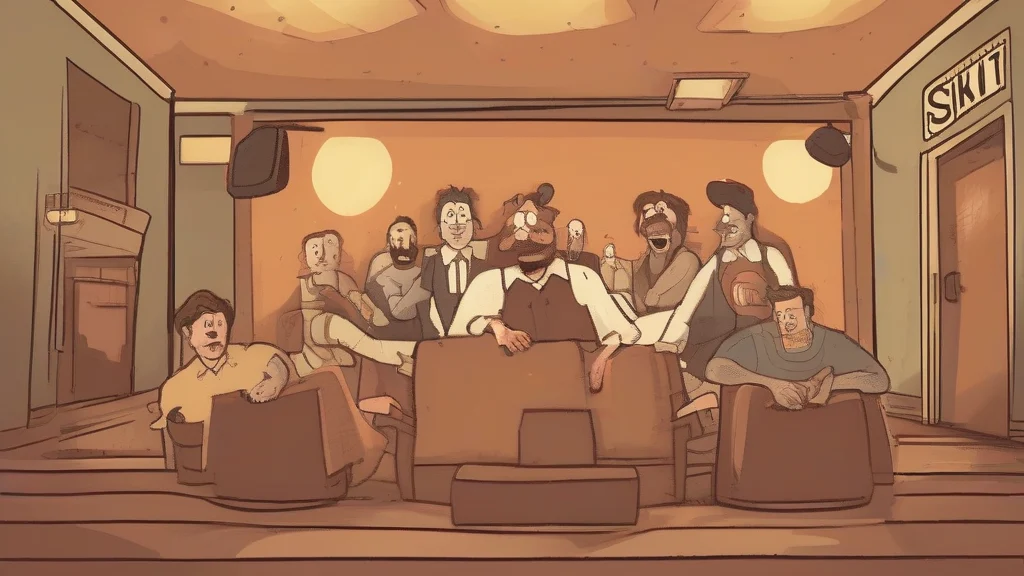
What does skit mean?
A skit denotes a brief comic or satirical dramatic piece, such as a scene performed onstage, a sketch on radio or television, or a short comic sequence in a film or online video. Its central feature is brevity: the audience receives a concentrated situation, often with a joke, parody, or sharp character sketch, rather than a sustained narrative. The word is especially natural in descriptions of comedy and entertainment, although a skit can also carry a critical tone when it satirizes a person, institution, or current event. A skit therefore need not be amusing in intent, but it is normally brief and theatrical. In modern general English, skit is a countable noun, with skits as its regular plural. Older and much less common uses include the verb skit, meaning to move or travel quickly, and an early noun sense referring to a shot or projectile. Today those older senses are mainly encountered in dictionaries, specialist writing, or quotations from earlier texts, while the theatrical and screen-related noun senses dominate.
A short comic or satirical performance, sketch, or scene, especially one presented onstage or in a film, television programme, or video.
"The festival opened with an energetic skit performed by the local comedy group."
The theatrical and screen senses are standard in British and American English. A skit may be humorous, satirical, or both.
To move or travel rapidly; in some uses, to skate.
"The skier skitted down the slope and disappeared into the distance."
This is a rare or dated verb in contemporary English and is much less common than the noun.
The regular plural of the noun is skits.
"The programme included several political skits written for television."
Before it meant quick comedy, a skit could mean a shot or projectile—a surprisingly literal journey from firing to delivering punch lines.
Reviewed by Deb Chak, Editor. AI-assisted content curated by RJS Tech Solutions LLP.
Where does skit come from?
Skit appeared in the early 17th century as a word for a shot or projectile and was probably borrowed from a Scandinavian source related to Old Norse skot, meaning a shot. Its early verb sense, meaning to move swiftly, also came through Scandinavian. By the early 20th century, skit had acquired the now-dominant sense of a short comic or satirical performance. The exact route of borrowing is uncertain, although the English words shot and shoot, as well as the less transparent scot, are related to the same broad Germanic root family.
Related word forms
How skit is actually used
In modern use, skit is usually an entertainment-context noun. It commonly denotes something humorous but may also refer to sharply critical satire. The verb is rare and now mainly encountered in dictionaries, specialist writing, or quotations from older texts.
Easily confused with skit
A skit, pronounced /skɪt/, is a brief comic or satirical performance, whereas a skate, pronounced /skeɪt/, is an ice sport, a blade fitted to a boot, or the act of gliding on ice.