
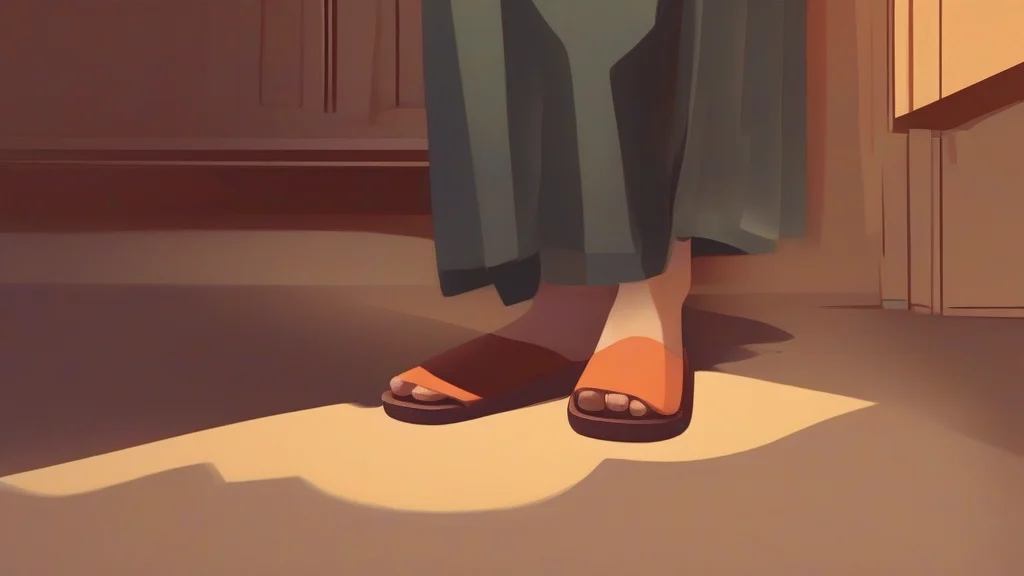
What does slippered mean?
Slippered describes a person whose feet are covered by slippers or whose footwear is visibly of that kind. It can function before a noun, as in “slippered feet,” or after a linking verb, as in “the guests were slippered.” The word is relatively uncommon in everyday conversation but has an established descriptive and literary quality, often drawing attention to the informal comfort of slippers within a more formal or carefully portrayed setting. Because slippers are loose indoor footwear, the expression may suggest ease, domesticity, privacy, or a small incongruity in an otherwise formal scene. It is closely associated with the noun “slipper,” from which the adjective was formed, and should not be confused with the ordinary past participle use in phrases such as “a slipped shoe,” where “slipped” describes a shoe coming off rather than the wearer having slippers on.
adjectiveWearing slippers, especially slippers that are visible rather than concealed by footwear.
- Wearing slippers; having slippers on one’s feet.
"The guests remained seated, their slippered feet gathered beneath the chairs."
"He padded across the room in his slippered feet."
"The old house was warm, and the family spent the evening in their slippered comfort."
A person may be formally dressed from the waist down while betraying a private comfort with slippered feet.
Reviewed by Deb Chak, Editor. AI-assisted content curated by RJS Tech Solutions LLP.
Where does slippered come from?
“Slippered” was formed from the noun “slipper,” an attested Middle English word for a loose indoor shoe. The adjective developed by adding the suffix “-ed,” a pattern used to indicate a person is wearing or equipped with something. The older noun belongs to a word family that also includes the plural “slippers,” while the modern adjective emphasizes the visible act of wearing this footwear.
Related word forms
How slippered is actually used
The word is relatively literary and descriptive. It is especially natural in phrases such as “slippered feet,” where it evokes a domestic, relaxed, or carefully observed detail.