
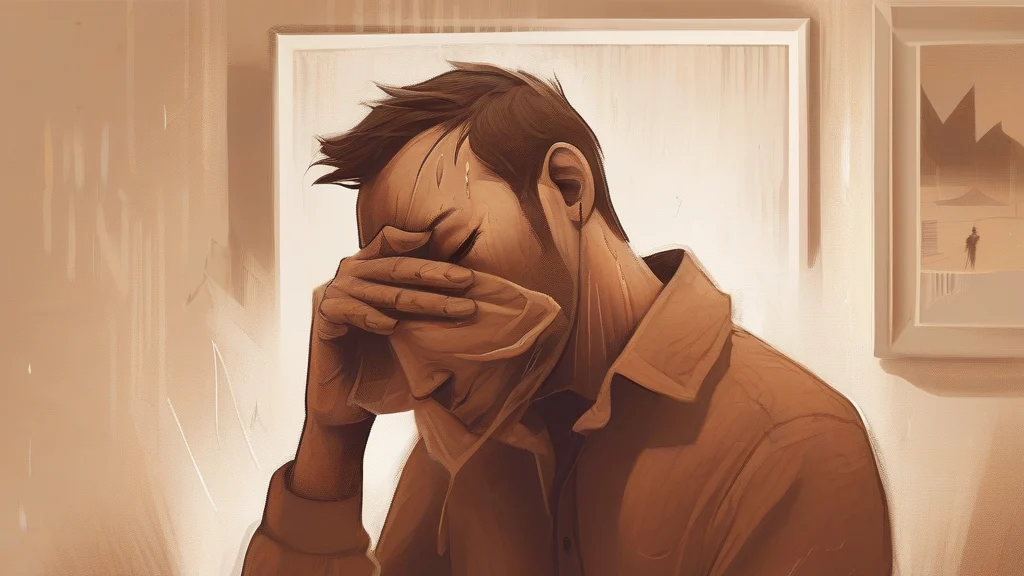
What does sob mean?
To sob is to cry noisily and with sudden, uncontrollable bursts, usually because of grief, fear, pain, or another overwhelming feeling. The related noun names the sound itself or an instance of this kind of crying. “Sob” is generally more intense than “cry” and more emotionally charged than “weep,” while “wail” suggests a particularly prolonged or mournful cry. In ordinary use, someone might burst into sobs, sob with grief, or be described as sobbing uncontrollably. Figuratively, the verb can describe a mechanical or environmental sound that resembles someone crying, such as an engine laboring uphill. The word appears in literary, journalistic, and dramatic contexts as well as in everyday descriptions of distress.
To cry noisily and uncontrollably, especially from grief, pain, or strong emotion.
"She sobbed quietly after hearing the news."
Usually describes repeated or spasmodic crying and often suggests grief or severe distress.
An act or sound of loud, involuntary crying caused by strong emotion.
"Her sobs echoed through the empty room."
Often used in the expressions “burst into sobs” and “break into sobs.”
The plural is used for individual acts or sounds of crying, as in “She was unable to stop her sobs.”
"The crowd broke into sobs when the score was announced."
A sob is grief given sound: it is not simply crying, but the body’s broken, involuntary response to overwhelming emotion.
Reviewed by Deb Chak, Editor. AI-assisted content curated by RJS Tech Solutions LLP.
Where does sob come from?
The verb and noun come from Old English sobban, with the related Old English noun sōb, both associated with loud crying. Modern English developed the pronunciation and emotional range familiar today, especially through the sustained form “sobbing.” The word is not commonly associated with a broad set of secure modern cognates, so its clearest relatives are the older grammatical forms preserved within English.
Related word forms
How sob is actually used
“Sob” is more emotionally intense than “cry” and usually suggests an involuntary, audible expression of distress. It can be used figuratively for sounds that resemble muffled weeping.
Easily confused with sob
A sob is a loud, emotionally intense cry, whereas a sigh is a long, often quiet breath released in response to emotion, fatigue, or relief.
A cry is a general term for expressing sorrow or distress, while a sob specifically involves repeated or spasmodic sounds of loud weeping.