
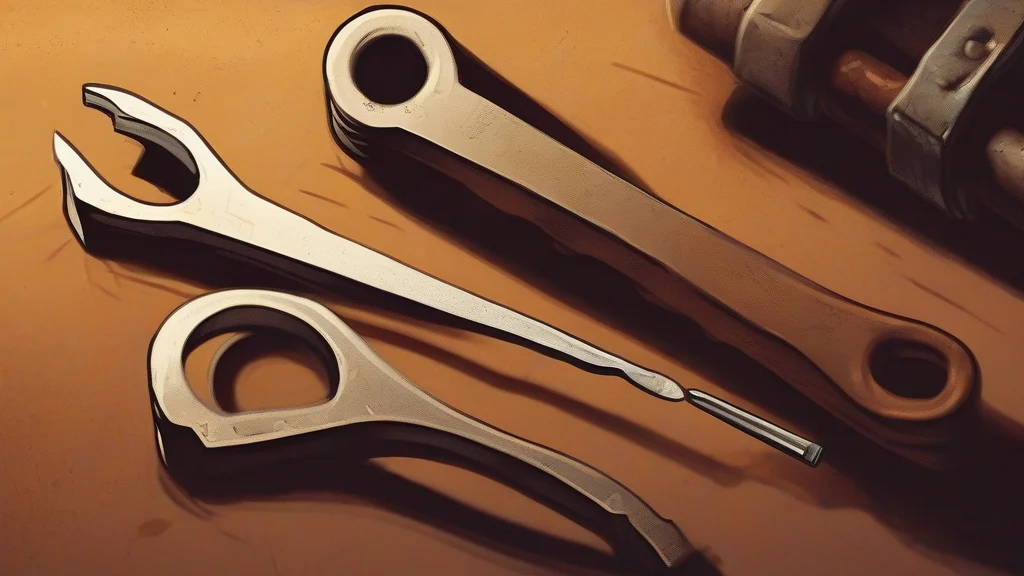
What does spanner mean?
Spanner most commonly denotes, especially in British English, a hand tool with shaped jaws or a ring used for gripping and turning nuts and bolts. It belongs to the vocabulary of mechanics, construction, and ordinary household maintenance, although in North America the word is more often encountered in figurative expressions such as a “spanner in the works,” meaning an obstacle that spoils an otherwise sound plan. The related verb, “to spanner,” means to disrupt or obstruct something. The metaphorical idea is especially memorable because one badly placed tool can prevent a much larger mechanism from functioning. While “wrench” is the usual American term for the tool and can also mean a spanner in British English, “spanner” has acquired a distinctive cultural identity through its vivid use as a metaphor for interference and bad luck.
A hand tool used to grip and turn nuts, bolts, and similar fittings; figuratively, a person or thing that disrupts plans or operations.
"She kept a set of spanners in the garage."
The literal tool sense is chiefly British, while the figurative sense is especially common in informal North American English.
To disrupt, spoil, or obstruct a plan or operation.
"The unexpected outage spannered the entire production schedule."
This is an informal verb, used more often in British English than in North American English.
The standard plural of the noun, used for multiple tools or multiple disruptive people or things.
"A row of polished spanners hung beside the workbench."
The humble British wrench became a global metaphor for a single obstruction capable of jamming an entire operation.
Reviewed by Deb Chak, Editor. AI-assisted content curated by RJS Tech Solutions LLP.
Where does spanner come from?
The word spanner appeared in British English in the late 19th century as a name for a tool, generally analyzed as span + -er, although the precise reason for applying that name to the tool is not entirely transparent. Its figurative sense, a person or thing that disrupts a plan, developed in the 20th century and became particularly familiar in American English, as in the expression “a spanner in the works.” The related inherited words span, spanning, and spend ultimately belong to the same Germanic and Indo-European root family associated with stretching or extending.
Related word forms
How spanner is actually used
The figurative noun and the verb are informal. In British English, spanner usually denotes the tool, while North American usage commonly emphasizes the metaphorical sense of a disruptive person or obstacle.
Easily confused with spanner
In British English, wrench can mean a spanner, whereas in American English it usually means an adjustable wrench, while spanner commonly means something that disrupts plans.