
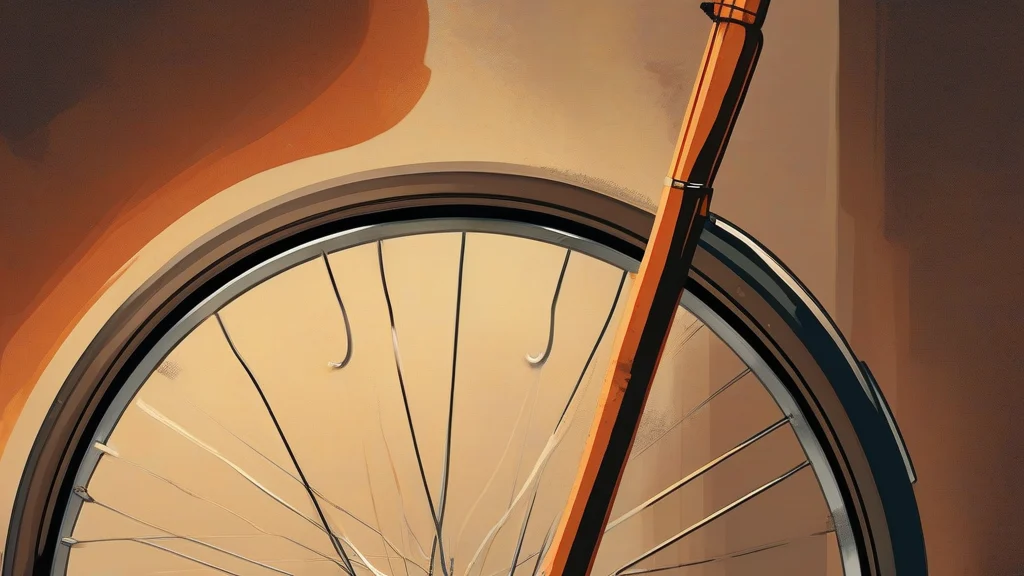
What does spoke mean?
Spoke has two distinct uses that are pronounced identically. As a noun, it denotes one of the rods or bars extending from the hub to the rim of a wheel, such as in a bicycle, cart, or gear mechanism. Spokes help distribute loads and maintain the wheel's shape, and a broken or loose spoke may cause vibration or wobbling. As a verb, spoke is the simple past tense of speak: it reports that someone said something or made a statement in the past. This form is especially common in narrative writing and formal reporting, where it may appear in constructions such as 'the minister spoke about the crisis.' The two meanings are easily distinguished by syntax: a spoke can be a physical component, while a person spoke or an official issued a statement. Although the functions are unrelated historically, modern usage allows the same spelling and pronunciation to serve both.
One of the rods or bars extending from the hub of a wheel to its rim, helping to support and shape the wheel.
"The wheel began to flex after one of its spokes came loose."
Usually countable, with the plural form 'spokes.'
The simple past tense of speak, used to describe something said or communicated in the past.
"She spoke briefly before the committee."
This is the simple past form; use 'spoken' where a past participle is needed.
The plural applies to the noun sense, as in 'the bicycle has broken spokes.'
"He carefully counted the spokes in the old cart wheel."
A wheel may have many spokes, but a single bent spoke can make an otherwise sound bicycle wobble.
Reviewed by Deb Chak, Editor. AI-assisted content curated by RJS Tech Solutions LLP.
Where does spoke come from?
The noun comes from Old English spāca, meaning a rod or bar of a wheel, and is related to forms such as Dutch spaak and German Spache. The verb is the simple past tense of speak, whose distinct origins include Old English specan and sprecan. Although the two meanings of the modern English word have different historical sources, both were established in English with the modern pronunciation /spoʊk/.
Related word forms
How spoke is actually used
The noun is standard in British and American English. The verb form is used with the same pronunciation and normally appears in simple-past contexts; 'spoken' is used when a past participle is required.
Easily confused with spoke
As a noun, a spoke is a component of a wheel; as a verb, it is the past tense of speak and is pronounced the same way.
Spoke is the simple past tense of speak, while spoken is the past participle, as in 'she spoke' and 'the spoken word.'