
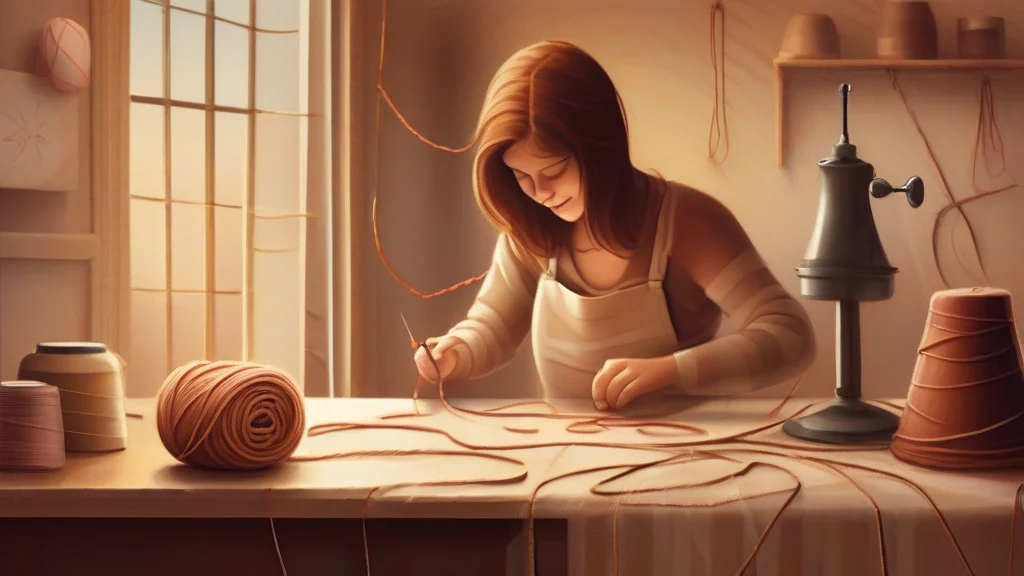
What does stitching mean?
Stitching is the process of joining material together with thread, as in sewing a garment, repairing a hem, or making a quilt. It can also refer collectively to the stitches or seams in a finished piece of cloth. The word is used for both precise manual techniques and the broader activity of sewing, including machine stitching and specialized craft work. In figurative language, stitching describes how separate parts are connected: writers may stitch together scenes, designers may stitch one visual idea to another, and people may speak of stitching communities or systems together. The term is practical and concrete, but carries a secondary sense of careful combination and repair. It is useful because it highlights not only the individual thread and loop but also the repeated action that creates a durable connection.
The act or process of sewing or joining material with stitches; the resulting stitches or seams collectively.
"Careful stitching gave the old jacket another decade of life."
Often used as a mass noun; a plural is uncommon.
To join or fasten something by sewing it together with stitches; figuratively, to connect separate parts into a whole.
"She is stitching the panels together before adding the lining."
Usually used as the present participle of 'stitch'; in the figurative sense, it often takes 'together.'
Stitching is normally a mass noun referring to a process or to stitches collectively; 'stitchings' is possible when referring to separate sets of stitches but is uncommon.
"The tailor checked the stitchings along the seam."
From ancient practice to modern fashion, stitching has joined pieces of fabric—and, in its figurative use, ideas and stories—together.
Reviewed by Deb Chak, Editor. AI-assisted content curated by RJS Tech Solutions LLP.
Where does stitching come from?
The noun and verb ultimately derive from Old English 'stitch,' related to Old Norse 'stik' and probably also to a Germanic root meaning to stick, pierce, or fasten. In Middle English, 'stitch' developed its sewing-related meanings, while 'stitching' came to denote the action or result of making stitches. The word also developed figurative uses for joining together parts, reflecting the physical practice of linking pieces of cloth.
Related word forms
How stitching is actually used
As a noun, 'stitching' is commonly used for the process or the finished sewn seams. As a verb, it is the present participle of 'stitch' and may function gerundively in phrases such as 'stitching by hand.' The figurative sense is especially common in discussions of writing, design, and narrative.
Easily confused with stitching
A stitch is an individual fastening or loop of thread, whereas stitching is the broader act or process of making stitches.
Steaming uses heat and often moisture to soften or set fabric, while stitching uses thread to join or fasten material.