
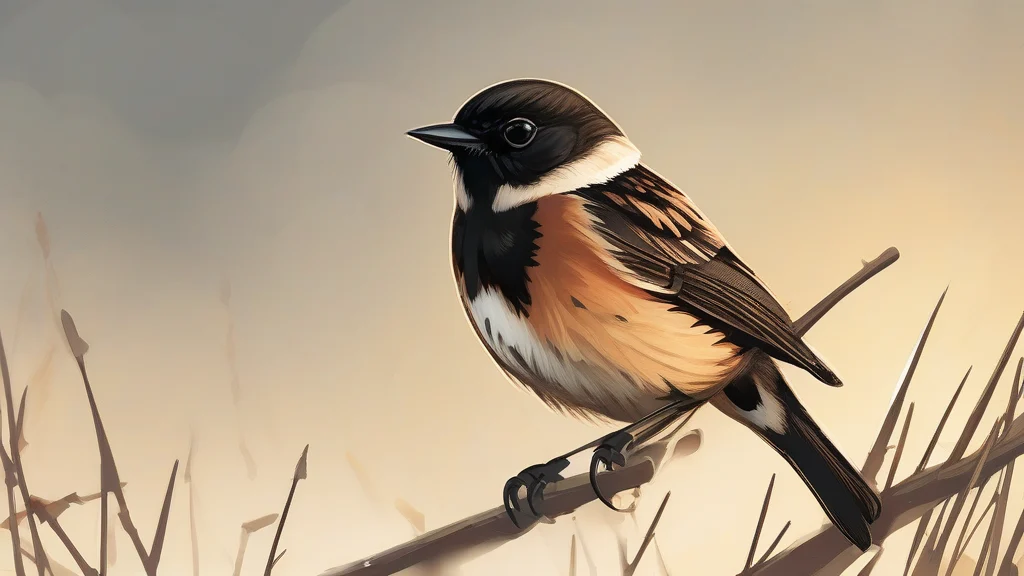
What does stonechat mean?
A stonechat is a small, conspicuous songbird belonging to the family Muscicapidae. The familiar European stonechat, Saxicola rubicola, is strongly associated with open countryside, including heathland, moorland, rough grassland, coastal scrub, and areas of gorse. Males are marked by a dark head, pale neck patches, and a warm orange-red breast, whereas females are generally browner and less vividly coloured. The bird often sits on a low bush, fence post, or exposed stone before dropping to the ground to feed on insects. Its tendency to perch visibly and call frequently makes it comparatively easy for birdwatchers to notice despite its small size. Stonechats are migratory, and European populations commonly spend winter in warmer parts of Africa and southern Asia. The name combines “stone” with “chat,” reflecting the bird’s association with conspicuous perches and its chattering vocalizations. In everyday English, however, “stonechat” is a specific bird name rather than a synonym for conversational chatter.
nounA small migratory songbird of the family Muscicapidae, especially the European stonechat (Saxicola rubicola). The male has a dark head, white neck patches, and an orange-red breast, while the female is browner and less strongly marked.
- A small migratory songbird, especially the European stonechat (Saxicola rubicola), traditionally associated with open country such as heathland, rough grassland, moorland, and gorse-covered ground.
"A stonechat called from the top of the gorse as the morning mist lifted from the hillside."
"We followed the trail until a stonechat flew from a fence post into the gorse."
"The reserve manager said that migrating stonechats return to the coastal scrub each spring."
The plural takes no final -s on the stem; it simply adds -s to the complete singular form.
"Several stonechats called from the roadside verge."
A male stonechat may return to the same exposed perch each morning, giving watchers a reliable chance to see its bold black-and-orange pattern.
Reviewed by Deb Chak, Editor. AI-assisted content curated by RJS Tech Solutions LLP.
Where does stonechat come from?
The word “stonechat” is formed from “stone” and “chat.” Its naming refers to the bird’s habit of perching visibly on stones and to its chattering call; “chat” ultimately derives from an Old English word meaning “to talk” or “chatter.” The compound name developed in English during the Middle English period.
How stonechat is actually used
In British and European English, the term normally denotes the European stonechat rather than every species of the genus Saxicola. In modern ornithological usage, other members of the genus often have distinguishing names, although the unqualified name may sometimes be used broadly outside Britain.
Easily confused with stonechat
A stonechat is a chat, related to robins and stonechats, whereas a wheatear belongs to the separate wheatear family and typically shows a white rump and tail.