
What does supernova mean?
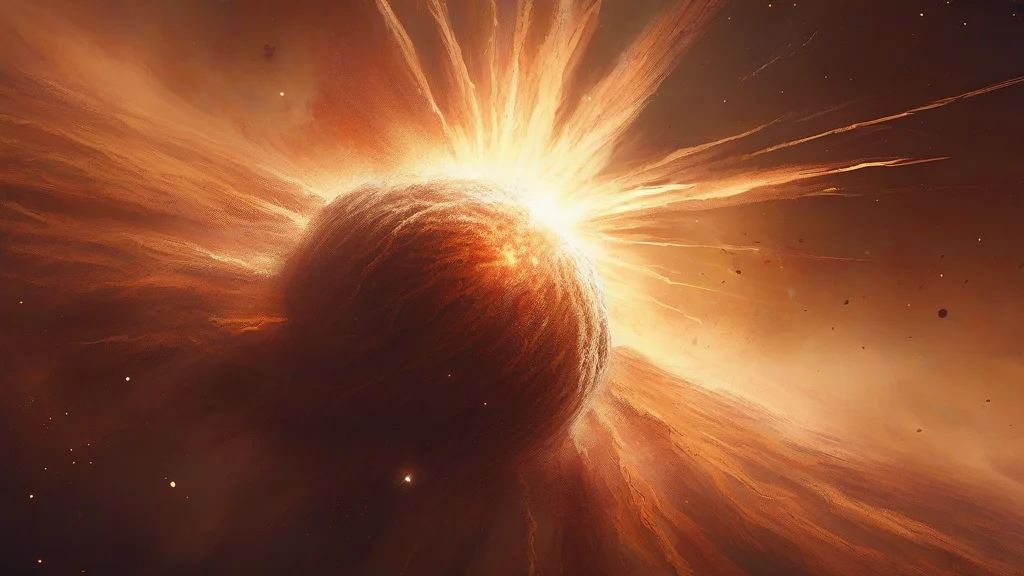
A supernova is a stellar explosion of exceptional brightness and energy. It can occur when a massive star exhausts its nuclear fuel and collapses under its own gravity, or when a white dwarf receives enough matter from a companion star to trigger a thermonuclear runaway. For a short period, a nearby supernova may appear brighter than some stars, planets, or even entire galaxies. The expanding debris left behind is called a supernova remnant and may contain a neutron star, a black hole, or enriched gas that eventually forms new stars. Supernova observations help astronomers study stellar evolution, the behavior of matter under extreme conditions, and the expansion and structure of the universe. The word combines the Latin elements super, meaning "above" or "beyond," and nova, meaning "new."
nounAn exceptionally energetic and luminous stellar explosion that occurs when a massive star undergoes gravitational collapse or when a white dwarf in a binary system accrets matter and reaches a critical mass. The term is also applied to exceptionally powerful explosions associated with other astronomical objects.
- The explosive destruction of a star, especially a massive star, that produces an extremely bright and energetic astronomical event.
- An exceptionally powerful and luminous astronomical explosion associated with phenomena such as gamma-ray bursts or the destruction of a white dwarf.
"The supernova was visible to the unaided eye and briefly rivaled the brightness of Venus."
"Astronomers observed the supernova in a distant galaxy and recorded its extraordinary brightness."
"The remains of a supernova can form a neutron star, a black hole, or a expanding cloud of gas and dust."
Supernovae is the traditional and preferred plural in formal astronomical writing; supernovas is common in general usage.
"Galaxies containing recently formed stars frequently host supernovae."
A nearby supernova can briefly outshine an entire galaxy before fading into a cosmic remnant.
Reviewed by Deb Chak, Editor. AI-assisted content curated by RJS Tech Solutions LLP.
Where does supernova come from?
Supernova was formed in English from Latin super, meaning "above" or "beyond," and nova, meaning "new," following the earlier astronomical term nova. The English word for a new star dates to the late 16th century and was borrowed from Latin, where novus means "new." The prefix super- distinguishes a supernova as an exceptionally powerful phenomenon rather than an ordinary nova.
How supernova is actually used
In general astronomy usage, supernova refers to a stellar explosion of exceptional luminosity. The word is often used attributively, as in "supernova remnant" and "supernova observer," while the plural is usually supernovae.
Easily confused with supernova
A nova is a relatively modest increase in a star's brightness caused by material being deposited on its surface, whereas a supernova is a vastly more powerful and destructive stellar explosion.