
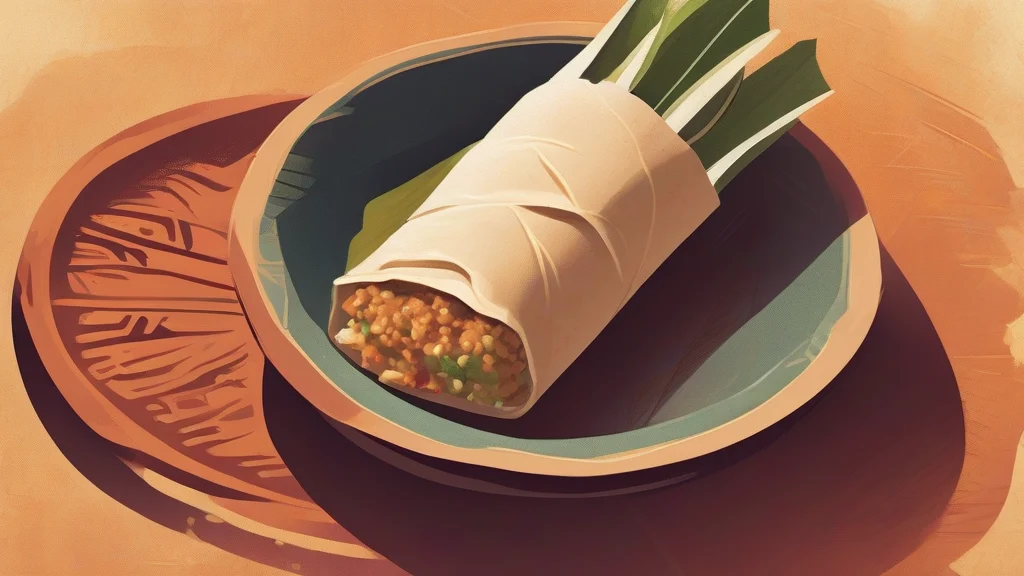
What does tamal mean?
A tamal is a savory food parcel or steamed cake whose defining feature is that its filling and grain-based outer mixture are enclosed in a natural wrapping and cooked, most often by steaming. Mexican-style tamales are made from masa and may contain meat, cheese, beans, vegetables, or chiles; the parcels are commonly wrapped in corn husks or banana leaves. South Asian tamal is a different preparation, traditionally made from rice and lentils or other legumes and seasoned with spices. The word can therefore suggest both a Mesoamerican tradition of food wrapped and steamed in leaves and a South Asian steamed rice-and-legume dish. It is useful for recognizing closely related foods that share the practical idea of enclosure and steaming but differ substantially in ingredients, seasoning, and cultural history.
nounA savory food parcel made from masa or another grain-based mixture, traditionally filled and steamed in a corn husk, banana leaf, or similar wrapping. In South Asian usage, the term also refers to a steamed cake made with rice and lentils or other legumes.
- A Mexican-style parcel of masa containing meat, cheese, beans, chiles, or another filling, wrapped in a corn husk or banana leaf and steamed.
- A South Asian steamed preparation made from rice and lentils or other legumes, often seasoned with spices.
"They served hot tamales with lime, salsa, and avocado at the market stall."
"Each tamal was filled with roasted vegetables and herbs before being wrapped in a corn husk."
"For breakfast, she served spiced potato tamal with chutney and yogurt."
Tamales is the standard English plural, especially for Mexican-style food parcels.
"The stall sold burritos, tamales, and bowls of spicy soup."
Wrapped and steamed in a leaf or corn husk, a humble mixture of cornmeal or rice becomes one of the world's most distinctive portable foods.
Reviewed by Deb Chak, Editor. AI-assisted content curated by RJS Tech Solutions LLP.
Where does tamal come from?
The English culinary term is commonly traced through Mexican Spanish tamal to Nahuatl tamalli, an ancestral word associated with wrapped or encased food. Spanish developed the form tamal, from which English borrowed the word; related forms include tamale and the Spanish tamalera. South Asian English also uses tamal for a rice-and-legume preparation, but its deeper historical relationship to the Mexican term should not be inferred merely from the shared spelling.
Related word forms
How tamal is actually used
In English, tamal is used in Mexican and South Asian culinary contexts. Tamale is also standard and may be more immediately recognizable to many North American speakers. The South Asian preparation is distinct from the Mexican food even though the terms overlap in international usage.
Easily confused with tamal
Tamal and tamale can refer to the same Mexican-style food, although tamale is the more familiar English form, while tamal is especially common in South Asian usage.