
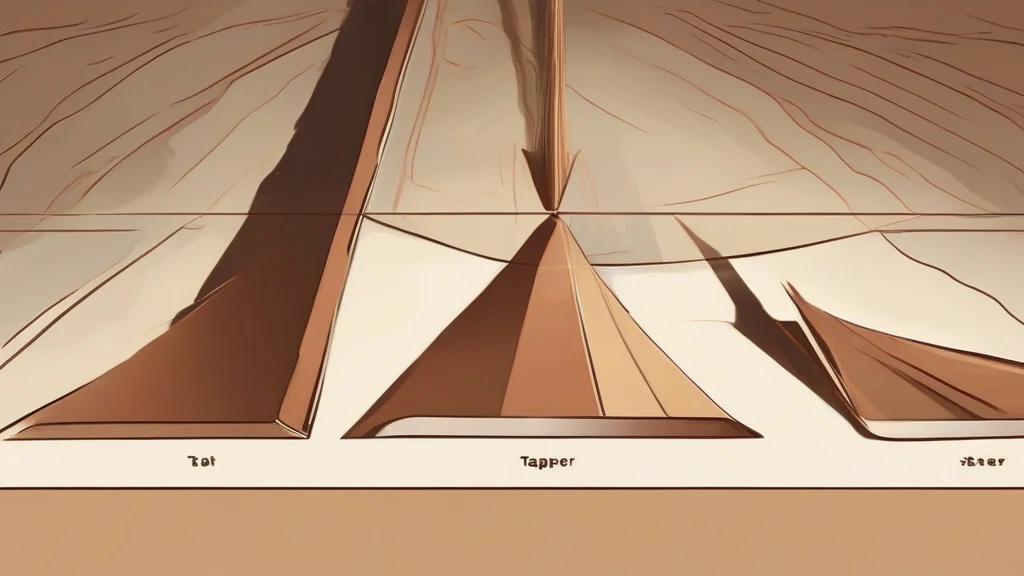
What does taper mean?
To taper means to diminish gradually, either in physical size or in quantity and intensity. A road, beam of light, or object may taper as it extends, becoming progressively narrower. In an economic or everyday context, a business, demand, effort, or conversation can taper off, meaning that it gradually becomes smaller or less active. The noun has several related uses: a taper is a slender candle, a small quantity of an alcoholic drink traditionally given as a measure, and a gradual reduction. The word can also refer to a narrow, pointed object or shape. Its defining feature is gradual narrowing or reduction rather than an abrupt change, making “taper” especially useful when describing developments that lose force, size, or intensity over time.
To become gradually narrower or smaller, or to cause something to become gradually smaller in size, amount, or intensity.
"The noise tapered off as the crowd dispersed."
A slender candle; a gradual reduction in size, amount, or intensity; or a narrow, pointed object or shape.
"The report described a steady taper in monthly sales."
The plural is used for individual slender candles or for distinct instances or stages of gradual reduction.
"The candle maker displayed a row of tapers of different lengths."
To “taper off” is to gradually reduce something, from a physical shape that comes to a point to a plan that slows to a stop.
Reviewed by Deb Chak, Editor. AI-assisted content curated by RJS Tech Solutions LLP.
Where does taper come from?
The word comes from Middle English taper, continuing Old English usage associated with a slender wax candle. The modern sense of gradually becoming narrower developed by analogy with the pointed or narrowing form of a candle. The verb meaning to reduce gradually developed later from this physical sense.
Related word forms
How taper is actually used
The verb is commonly used with “off” when describing a gradual reduction in activity, effort, or intensity. “Taper” is neutral in register and can describe both physical dimensions and abstract quantities.