
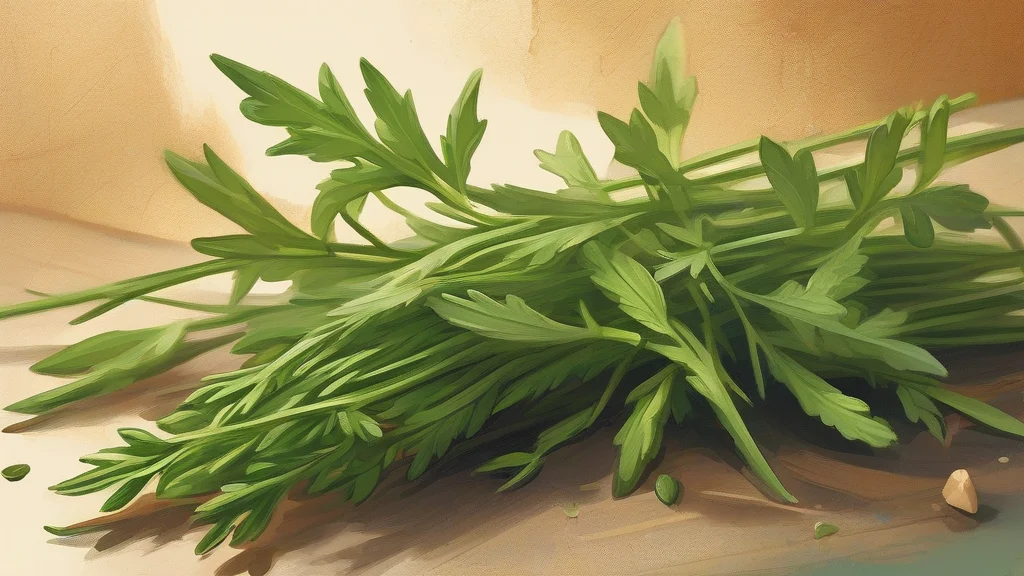
What does tarragon mean?
Tarragon is an aromatic herb whose narrow green leaves have a distinctive flavor often described as sweet, mildly bitter, and anis-like. It is especially associated with French and European cooking, where it may appear in sauces, dressings, soups, and dishes involving chicken, fish, eggs, or beef. Fresh leaves are generally valued for their aroma, while dried tarragon has a more concentrated flavor and is commonly used in seasonings, mustard, and vinegar. The herb is not itself hot or sweet like chervil, so it contributes fragrance and seasoning rather than bulk. Although now familiar chiefly as a kitchen herb, tarragon also has an older heraldic meaning of “dragon.” Its modern name preserves a curious historical link with the dragon of medieval legend and folklore. The word can be used for both the living plant and the leaves used in cooking, and it appears in standard expressions such as fresh tarragon, dried tarragon, and tarragon vinegar.
nounAn aromatic perennial herb with narrow leaves and a distinctive, slightly sweet flavor, used as a seasoning in sauces, soups, and salads. Its name also refers, rarely, to a dragon in heraldry.
- The aromatic culinary herb known as Artemisia dracunculus, used fresh or dried to season food.
- A dragon, especially in heraldic terminology.
"The sauce was finished with fresh tarragon and a splash of white wine."
"Add chopped tarragon to the vinaigrette just before serving it."
"The label identifies the creature as a tarragon passant, the heraldic term for a walking dragon."
Uncommon. Usually tarragon is treated as an uncountable noun when referring to the herb as a seasoning; the plural is more natural when distinguishing individual plants or sprigs.
"Several tarragons grew along the sunny edge of the garden."
The word hides a dragon: its name reaches back through Latin and Greek to drakōn, meaning “dragon,” an echo of the herb's old reputation for remarkable powers.
Reviewed by Deb Chak, Editor. AI-assisted content curated by RJS Tech Solutions LLP.
Where does tarragon come from?
English borrowed the word through French targon, which in turn came from a medieval Latin form such as tarchon or targon. This Latin word is generally understood to derive from Ancient Greek drakōn, meaning “dragon,” probably reflecting an old belief that the herb could neutralize or resist poison. The same Greek root also produced words such as dragon, draconic, and Draco.
How tarragon is actually used
In culinary contexts, tarragon is normally treated as an uncountable mass noun. A plural is occasionally used for individual plants or sprigs, but “a sprig of tarragon” or “some tarragon” is more natural.