
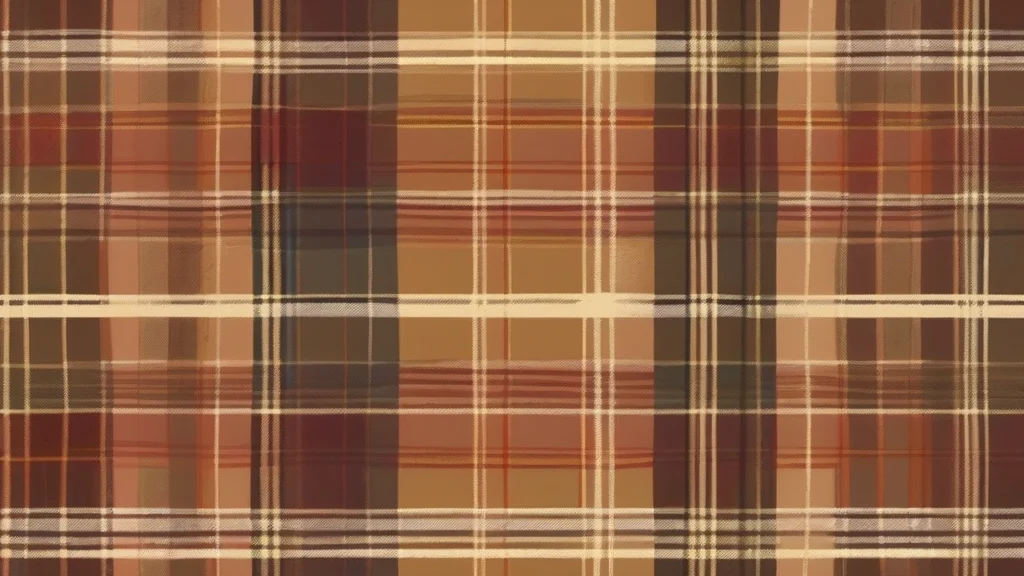
What does tartan mean?
Tartan is a woolen or similarly woven cloth characterized by intersecting colored bands that form checks or squares. Its best-known use is in Scottish Highland dress, where distinct clan or regional tartans can communicate identity and heritage; similar checked fabrics are also made in many other places and have long been used for skirts, trousers, scarves, and coats. As an adjective, tartan means made from this checked fabric or patterned in the same distinctive way. The word is especially associated with Scotland and appears frequently in descriptions of kilts and clan dress, but its basic material sense is fully established in both British and American English. In American usage, plaid is often the more common everyday term for a checked fabric, while tartan retains a somewhat more specific Scottish and heritage-laden flavor. Tartan can also refer to the repeatable checked design itself, not merely the cloth carrying it, making it a useful word for discussing both material and pattern.
A woolen or similarly woven cloth with intersecting colored bands forming checks; also a particular checked design, especially one associated with a Scottish clan.
"The kilt was made from red tartan."
The material sense is usually uncountable, while the plural can refer to distinct checked patterns.
Made of tartan or patterned with the characteristic intersecting bands of tartan.
"He wore a tartan jacket and matching trousers."
Outside Scottish cultural contexts, the adjective has a neutral material or pattern meaning.
To make, cover, or decorate something with tartan.
"The costume designer tartaned the panels in deep green."
This use is infrequent and more specialized than the noun and adjective.
Tartan is normally uncountable when referring to the material; the plural is used for separate checked designs or patterns.
"The archive includes tartans associated with several Scottish regions."
A tartan can function like visual identification: its color-and-check pattern may signal a Scottish clan or region.
Reviewed by Deb Chak, Editor. AI-assisted content curated by RJS Tech Solutions LLP.
Where does tartan come from?
Tartan entered English in the eighteenth century from French tartan, a term whose ultimate source is uncertain. The English word originally referred to a checked woollen fabric associated with Scotland and later came to denote individual checked designs and clan patterns.
Related word forms
How tartan is actually used
Tartan has strong Scottish cultural associations and can suggest clan identity, heritage, or ceremonial dress. Its general checked-fabric sense is neutral and common in both British and American English, although the verb is infrequent and specialized.
Easily confused with tartan
Plaid is the usual broad synonym in American English, while tartan specifically emphasizes a checked woven fabric or design and is especially associated with Scottish Highland dress.