
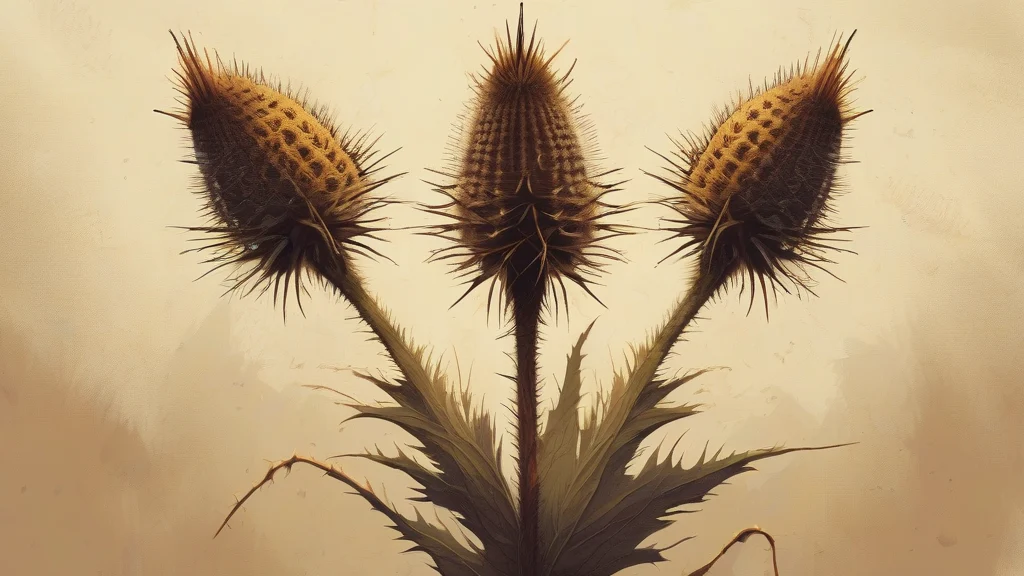
What does teasel mean?
Teasel is the name of a prickly herb whose bristly, hooked flower heads readily catch on animals and clothing. The best-known species is fuller's teasel, a traditional source of the stiff heads used by cloth finishers to raise the nap of wool and other woven fabrics. Consequently, teasel can also refer to the dried flower head or a similar tool used for this purpose. The related verb teasel means to raise a fabric's nap with such a head; in general modern usage, however, tease is more usual for the act of provoking or playfully pestering someone. The word has an appealingly practical history: medieval and early modern textile workers used a naturally bristly plant as a precision finishing tool long before mechanical substitutes became available. Today, teasel most often denotes the plant itself, while its textile sense survives in specialist vocabulary and descriptions of traditional craft.
A prickly plant of the genus Dipsacus, especially fuller's teasel, or one of its bristly flower heads or textile-finishing tools.
"The gardener left a clump of teasel growing beside the path."
When referring specifically to the plant or its bristly head, teasel is usually singular; plural teasels refers to multiple plants or heads.
To raise the nap of cloth using a teasel; also, to tease.
"The workers teaseled the wool before packing it for shipment."
The textile sense is rare and specialized, while the form also occurs as a less common equivalent of tease.
The standard plural refers to multiple teasel plants, flower heads, or implements.
"Several dried teasels were hung ready for finishing the cloth."
Before powered machines, dried teasel heads gave wool its soft raised nap—an ancient plant-powered finishing tool.
Reviewed by Deb Chak, Editor. AI-assisted content curated by RJS Tech Solutions LLP.
Where does teasel come from?
Teasel descends from Old English tæsel, the name of the plant and, by extension, its bristly head used in cloth finishing. Old English tæsel is cognate with Dutch distel and German Distel and is related to the root preserved in tease. The specialized textile verb developed from the established use of teasel heads to raise the nap of woven fabric.
Related word forms
How teasel is actually used
As a plant name, teasel is standard in British and American English. As a verb, its textile sense is uncommon outside descriptions of cloth finishing; tease is normally used for provoking or playfully pestering someone.
Easily confused with teasel
To tease someone is to provoke or playfully pester them, whereas to teasel cloth is to raise its nap with a bristly teasel.
A teasel is a plant whose hooked bristles catch onto animals and whose flower heads were used in cloth finishing; thistles have more sharply spiny foliage and flowers.