
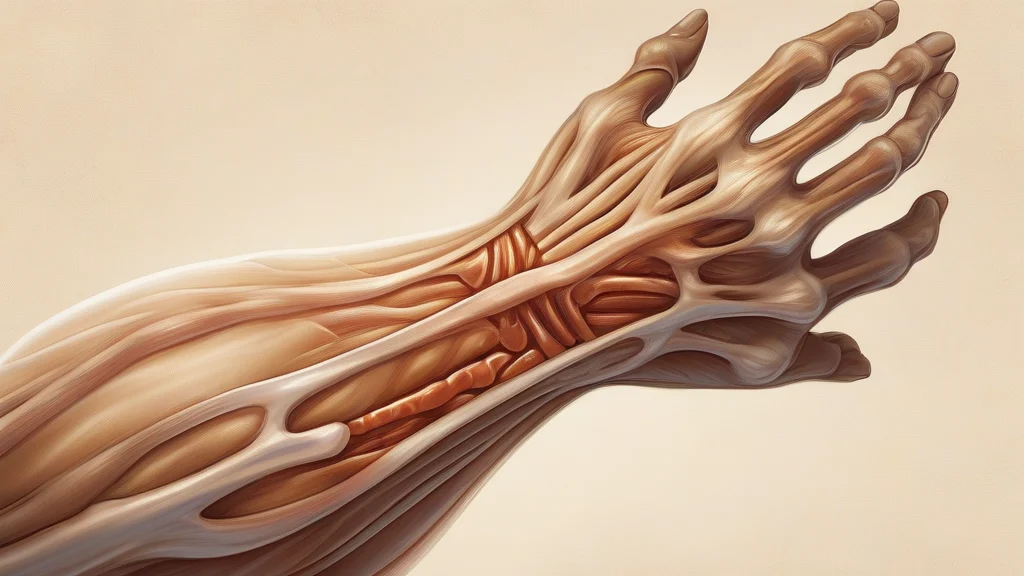
What does tendon mean?
A tendon is a strong, flexible band of connective tissue that joins a muscle to a bone and transmits the force produced when the muscle contracts. This makes tendons essential to movement: they allow muscles to pull on bones across or around joints. Familiar examples include the Achilles tendon at the heel and the tendons that control the fingers and toes. The word is common in medicine, anatomy, sport, and physiotherapy, particularly when discussing injuries such as inflammation, tearing, or rupture. Although people sometimes use tendon and ligament interchangeably, the distinction is important: a ligament connects bones or bone to cartilage, while a tendon connects muscle to bone. In figurative use, the related word sinew can suggest physical strength, endurance, or emotional vitality, but tendon itself normally refers literally to anatomical tissue. Its usefulness as a word lies in naming the specialized structures that make muscular movement possible.
nounA tough band of connective tissue that attaches muscle to bone and transmits the force of muscle contraction. Tendons may also connect muscle to muscle or other structures.
- An anatomical band of tough connective tissue that attaches muscle to bone and transmits tensile force.
"The Achilles tendon carries force from the calf muscles to the heel bone."
"The surgeon repaired the damaged tendon in the patient's shoulder."
"A sudden increase in training can put a horse's tendon under excessive strain."
The standard plural is tendons, with no additional inflection.
"The tendons in the hand allow its fingers to grip and manipulate objects."
Think of a tendon as the body's living cable, translating a muscle's power into movement.
Reviewed by Deb Chak, Editor. AI-assisted content curated by RJS Tech Solutions LLP.
Where does tendon come from?
English borrowed tendon in the late Middle English period through Medieval Latin, ultimately from Greek tenōn, meaning “tendon.” The Greek word is related to teinein, “to stretch,” reflecting the tissue's role in transmitting tension. Related English words such as tend, tendency, and tension reflect the same broad Indo-European idea of stretching or extending.
Related word forms
How tendon is actually used
Tendon is standard in medicine, anatomy, sport, and physiotherapy. It is technical rather than literary, though the related word sinew has a figurative sense involving strength or vitality.
Easily confused with tendon
A tendon connects muscle to bone, whereas a ligament connects bone to bone or bone to cartilage.
Tendonitis is an alternative spelling of tendinitis, the medical term for inflammation of a tendon.