
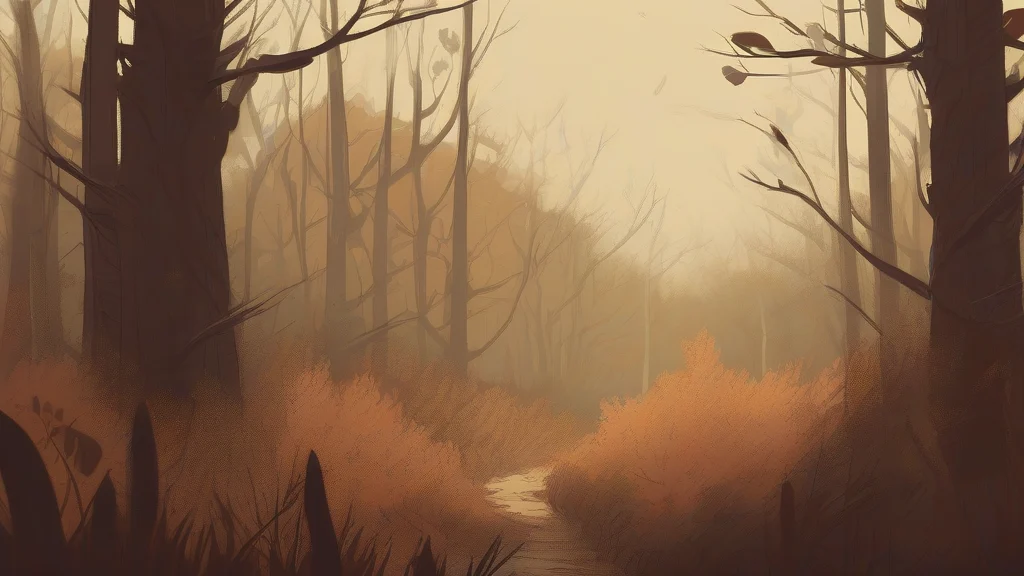
What does thicketed mean?
Thicketed is a rare, literary adjective meaning covered with thickets or so overgrown with tangled shrubs that the vegetation dominates the landscape. It is especially useful in descriptive writing, where it compresses the picture of a path, wood, or hillside disappearing into dense undergrowth. Although “thicket” is an ordinary noun, “thicket” as a verb is now archaic or obsolete; in that older use, the verb means to form or make a thicket. In ordinary modern prose, however, the word is usually an adjective meaning overgrown or densely tangled with shrubs. The term has a slightly elevated, almost poetic register, so it suits atmospheric descriptions more readily than neutral everyday sentences. Its value lies in evoking both luxuriance and obstruction: vegetation does not merely line the landscape but fills it. Although uncommon, it remains transparent enough for readers to infer its meaning immediately from “thicket” and the ending “-ed.”
Covered with thickets; overgrown or densely tangled with shrubs and tangled vegetation.
"A thicketed verge bordered the narrow country road."
Literary and uncommon; often used for vividly overgrown or enclosed places.
The obsolete verb “thicket” means to make or form a thicket; “thicketed” is its simple past tense and past participle.
"The grounds had been thicketed with briars and low woodland."
This sense is archaic or obsolete and may be difficult for modern readers to distinguish from the participial adjective.
Its ancestor was Old English þiccet, a word for a dense mass of shrubs: thicketed preserves that old sense of land almost hidden by vegetation.
Reviewed by Deb Chak, Editor. AI-assisted content curated by RJS Tech Solutions LLP.
Etymology of thicketed
Thicketed was formed within English from “thicket,” which continues Old English þiccet, a noun based on “thick” with the suffix “-et.” English later developed an adjective “thicket” and an obsolete verb “thicket” from the same base. The adjective “thicket” was extended to the participial form “thicketed,” while the older verb also produced “thicketed” as its simple past tense and past participle.
Related word forms
How thicketed is actually used
As an adjective, thicketed is literary and uncommon, with a slightly poetic or archaic flavor. Its use may sound descriptive or atmospheric rather than neutral. In older writing, it can also be read as a past form of the now obsolete verb “thicket.”
Easily confused with thicketed
A thicket is the dense mass of shrubs itself; thicketed is an adjective describing ground or vegetation covered by thickets.