
What does thistle mean?
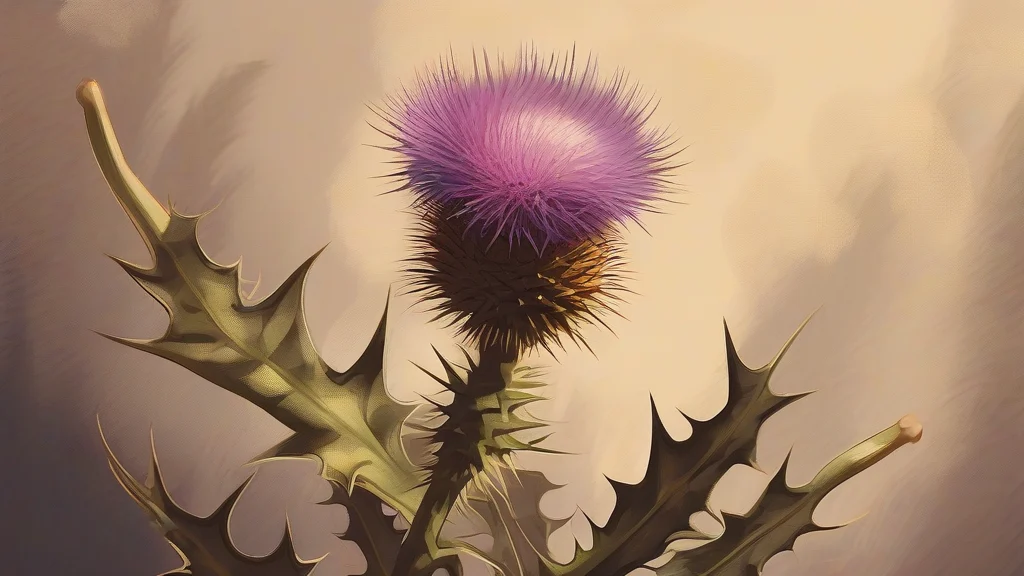
Thistle is a common name for a prickly herbaceous plant, especially members of the genus Cirsium and several closely related genera in the daisy family. Its leaves and often its flower heads bear sharp spines, making the plant recognizable even before its purple, pink, or occasionally white blossoms open. In ordinary use, the word usually refers to a single plant or to thistles growing as weeds, often in fields, roadsides, and rough pasture. The word is neutral in tone and generally describes the plant itself, although writers may borrow its prickly appearance to suggest defensiveness or resistance. Because of its tough growth and formidable spines, the thistle has long carried associations with resilience and endurance. It is also the national emblem of Scotland, which gives the otherwise ordinary wildflower a distinctive cultural identity. In everyday English, “thistle” needs no special knowledge to understand, but it is a useful, vivid word for both a recognisable plant and a familiar symbol of prickly toughness.
nounA prickly herbaceous plant with sharp spines on its leaves or flower heads, especially any of various plants of the daisy family, such as those in the genera Cirsium and Carduus.
- A prickly herbaceous plant, especially one of the numerous plants commonly called thistles, with sharply spined leaves or flower heads.
"A purple thistle grew beside the weathered stone wall."
"He brushed past a thistle and left a scratch on his arm."
"Purple thistles lined the path and hummed with visiting bees."
The regular plural is formed by adding -s.
"Thistles grew densely along the dry stone wall."
With a sharp defense and a prickly attitude, the thistle became Scotland's national emblem—proof that toughness can look elegantly spiky.
Reviewed by Deb Chak, Editor. AI-assisted content curated by RJS Tech Solutions LLP.
Where does thistle come from?
The English word descends from Old English þistle and was inherited from Proto-Germanic *þistlaz. It is cognate with Dutch distel, German Distel, Icelandic þistill, and the historical Old High German form thistula. The precise pre-Proto-Germanic origin of the word is uncertain.
Related word forms
How thistle is actually used
The term is generally neutral and countable. In figurative writing, it may evoke toughness, defensiveness, or resistance, but such extended meanings are less formal than the botanical sense.