
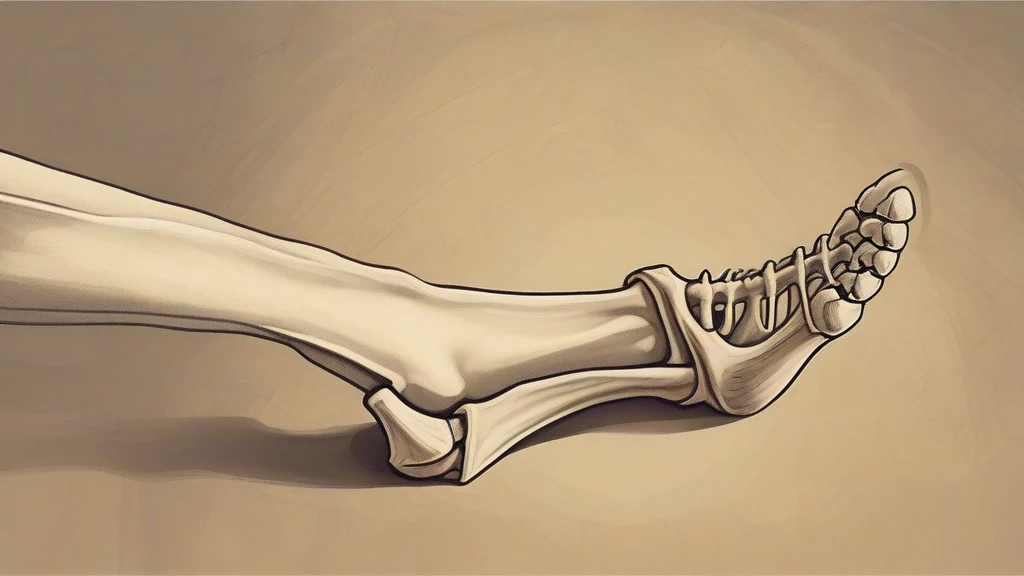
What does tibia mean?
The tibia is the large, weight-bearing bone of the lower leg. It forms the knee joint with the femur and the ankle joint with the talus, while the slimmer fibula lies beside it. In medical contexts, injuries such as fractures are commonly discussed in relation to the tibial shaft or tibial plateau. The word has a second, largely historical meaning: an ancient Roman pipe, probably a reed instrument, known by the same Latin name as the shin bone. Although the musical sense is uncommon today, it gives the word an unusual connection between Roman music and human anatomy. Tibia is used in both British and American English and is normally treated as a countable noun, with tibiae as its standard plural.
nounThe tibia is the larger and weight-bearing bone of the lower leg, situated between the knee and the ankle. The word can also denote an ancient Roman wind instrument, a type of pipe.
- The larger bone of the lower leg, extending from the knee to the ankle and articulating with the femur at the knee and the talus at the ankle.
- An ancient Roman wind instrument, generally understood as a reed pipe.
"The scan showed a hairline fracture in the patient's tibia."
"The tibia is the shin bone, while the thinner fibula runs alongside it."
"The musician demonstrated an ancient Roman tibia reconstructed from archaeological evidence."
The standard plural is tibiae.
"The radiographs showed fractures in both tibiae."
The tibia carries most of the body's weight when you stand, walk, or run—and its name also survives from the pipes of ancient Rome.
Reviewed by Deb Chak, Editor. AI-assisted content curated by RJS Tech Solutions LLP.
Words that share this root
Related word forms
How tibia is actually used
In medicine and anatomy, tibia is standard and usually refers specifically to the bone rather than the entire lower leg. The musical sense is historical and uncommon in modern usage.
Easily confused with tibia
A tibia may refer to the shin bone or an ancient Roman pipe, whereas a tuba is a modern brass instrument with a broad, cup-shaped bell.