
What does timpani mean?
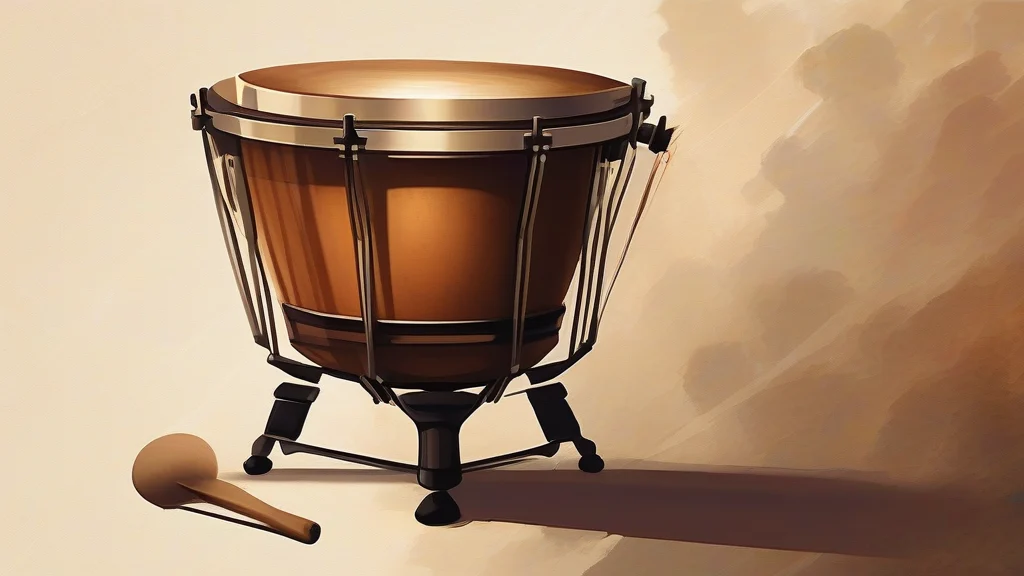
Timpani are large, tunable kettledrums whose copper bowls are covered with stretched skins and whose pitches can be adjusted by changing the tension of the skin. They are especially prominent in orchestras, where they provide forceful rhythmic accents, thunderous effects, and occasional pitched musical lines. Although the word is plural, it commonly refers to the complete set of drums rather than to a single instrument. In everyday reference, the term may be confused with the singular 'timpanum' or with the older expression 'kettledrums,' but 'timpani' is the established modern orchestral name. A musician who plays the instrument is called a timpanist, a role traditionally associated with the ability to hear and produce precise pitches while keeping time with the ensemble. The word is common in formal music contexts but can also appear in descriptions of concerts, compositions, and recording performances.
nounTimpani are a set of large, tunable kettledrums used in orchestral and percussion music, usually with a range of pitches. The word is the plural of the uncommon singular form timpanum.
- A set of large, tunable kettledrums used in orchestral, band, and percussion music.
"The timpani gave the symphony a powerful, thunderous opening."
"A burst from the timpani shook the hall during the final movement."
"She practiced a difficult passage on the timpani before the rehearsal."
Standard plural form, normally treated as plural-only; 'timpanos' is an occasional alternative.
"The orchestra included timpani in its percussion section."
Timpani can change pitch on command, letting a drummer turn a pair of drums into a thunderous melodic voice.
Reviewed by Deb Chak, Editor. AI-assisted content curated by RJS Tech Solutions LLP.
Where does timpani come from?
The word entered English through Italian, where timpani is the plural of timpano. Italian timpano derives from Latin tympanum, a drum or tambourine, which comes from Greek tympanon, associated with a drum and the sound produced by striking a stretched membrane. The same Greek and Latin roots appear in cognates such as tympanic and tympanitis.
Related word forms
How timpani is actually used
Usually treated as a plural-only noun. 'Timpani' can refer to one or more drums collectively, while the singular 'timpanum' is uncommon in modern usage.
Easily confused with timpani
Timpanum is the uncommon singular form, whereas timpani is the usual plural name for the instrument or set of drums.