
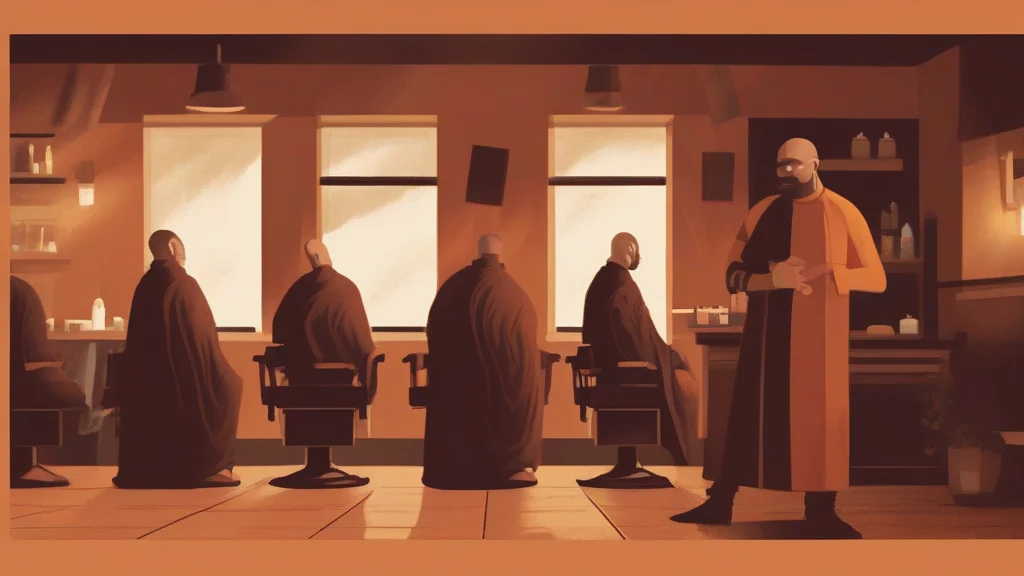
What does tonsor mean?
A tonsor is a barber, especially one who worked in ancient Rome. The word is uncommon in contemporary English and is most often encountered in historical writing, classical studies, or deliberately archaic prose. In Roman society, barbers occupied an important place in public and domestic life, and the Latin term tonsor came to represent the barber’s trade more broadly. Modern speakers may encounter it through descriptions of ancient hairstyles, grooming, or social customs. Although it can sound quaint or pedantic when used outside a historical setting, it is precise and evocative in a period context. The word is related to tonsure, meaning the shaving of the head, and to the adjective tonsorial, meaning connected with a barber or barbering. Understanding tonsor therefore provides useful access to the vocabulary of Roman social life and the long history of Western barbering.
nounA barber, especially a barber in ancient Rome. The word is now chiefly historical or literary.
- A barber, especially in ancient Rome.
"The Roman tonsor was an important member of the household, serving the family from a chair beside the street."
"In ancient Rome, a tonsor shaved clients and attended to their grooming."
"The word tonsor survives in historical writing, where it lends an antiquarian flavour."
The regular plural is used when referring to more than one barber.
"Roman tonsors served soldiers, citizens, and members of wealthy households."
A tonsor was a barber: the word also lives on in tonsure, the shaving of the head.
Reviewed by Deb Chak, Editor. AI-assisted content curated by RJS Tech Solutions LLP.
Where does tonsor come from?
Tonsor comes from Latin tonsor, meaning “barber,” a noun derived from tondere, “to shave” or “to clip.” The same Latin root also underlies tonsure and tonsorial, while the now-archaic English verb tond reflects the same shaving tradition. The English word preserves the Latin sense while ordinarily carrying a historical or literary register.
Related word forms
How tonsor is actually used
Chiefly historical, literary, or archaizing in modern English. In discussions of ancient Rome, it may refer more specifically to a professional barber rather than to a barber in the ordinary modern sense.
Easily confused with tonsor
A tonsor is a barber, whereas a tonsure is the act of shaving the head or the hairstyle produced by it.