
What does tortuousness mean?
Tortuousness is the quality of being winding, circuitous, or unnecessarily indirect. Its clearest physical sense applies to roads, rivers, and routes that twist rather than proceeding directly. In more abstract contexts, it describes arguments, negotiations, policies, or forms of conduct that are difficult to follow and may suggest evasion, excessive complication, or deliberate indirection. The word is formal and commonly critical: people may admire a tortuous process for its craftsmanship, but they rarely use the noun approvingly. Tortuousness is related to the adjective tortuous and should not be confused with torturous, which describes something painful or severe. The distinction is especially useful when discussing a winding path, a complicated political maneuver, or the harsh conditions of a journey. Its Latin roots reinforce the image of something twisted, while its modern use extends that physical idea to the complicated movement of language and strategy.
nounThe quality of being tortuous, especially of being winding, indirect, or circuitous. It can also describe devious or excessively complicated reasoning or conduct.
- The quality of being winding, twisting, or circuitous, especially of a path or route.
- Indirectness, evasion, or complexity in reasoning, negotiation, or conduct.
"The tortuousness of the negotiations frustrated everyone who had hoped for a swift agreement."
"The tortuousness of the mountain path made the journey longer and more exhausting than expected."
"She grew impatient with the tortuousness of the committee's discussions and asked for a direct answer."
The plural is grammatically standard but uncommon; writers usually prefer a singular construction or a related plural such as complications.
"The report contrasts the clarity of the proposal with the tortuousnesses of several competing plans."
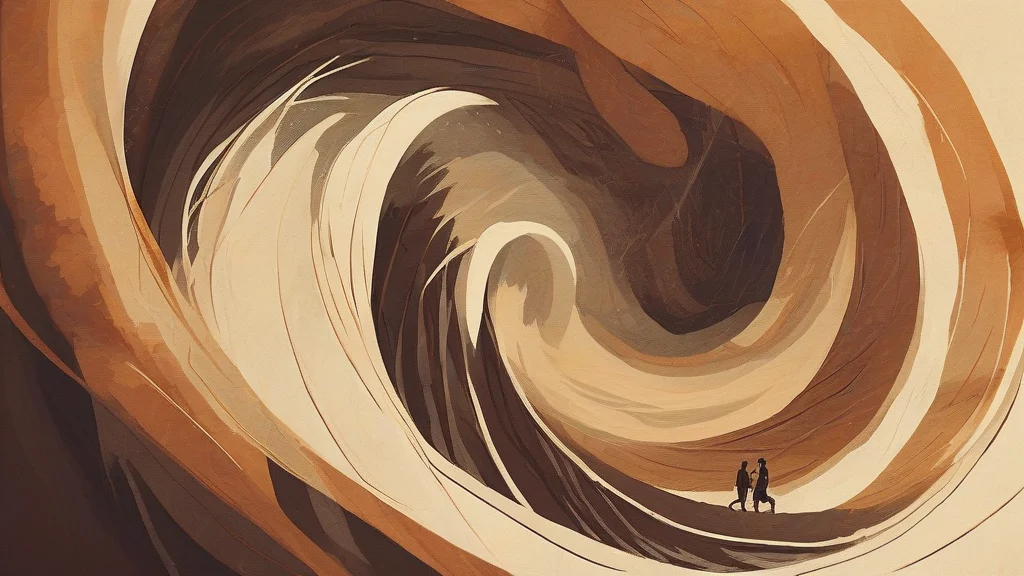
Tortuousness turns a direct route into a maze, describing both physical winding and the evasive complexity of language or strategy.
Reviewed by Deb Chak, Editor. AI-assisted content curated by RJS Tech Solutions LLP.
Where does tortuousness come from?
Tortuousness is formed from tortuous with the suffix -ness. Tortuous comes through French from Latin tortuosus, meaning “full of twists” and derived from tortus, the past participle of torquere, “to twist.” The English noun therefore continues a long-established Latin image of bending, turning, and indirectness.
How tortuousness is actually used
This is a formal, abstract noun. It is most often used to characterize routes, processes, arguments, negotiations, or political behavior, with connotations of needless complexity, evasion, or lack of straightforwardness.
Easily confused with tortuousness
Tortuousness is a noun meaning windingness or indirectness, whereas torturous is an adjective describing something painful, severe, or difficult.