
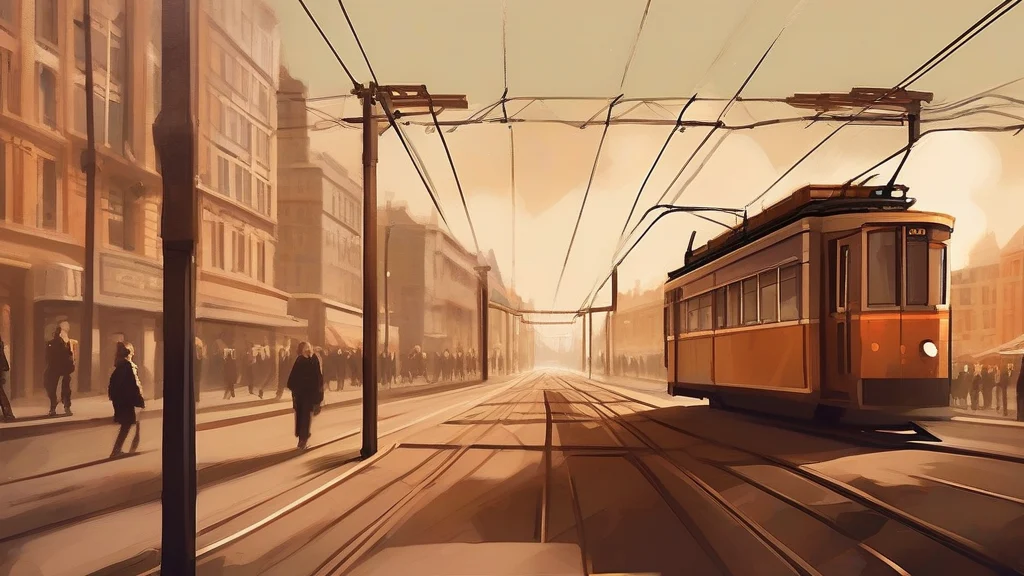
What does tramway mean?
A tramway is a track, route, or system used by trams. The term can refer narrowly to the permanent rails and associated infrastructure, or more broadly to the complete tram network and its operation. In everyday British English, it is especially associated with urban public transport and may evoke older city streets, industrial towns, and the expansion of electric tram services in the late nineteenth and early twentieth centuries. In American English, tramway is less common and often appears in historical or transport-technical contexts; street railway is a more usual American expression. A tramway should not be confused with a tram itself: the tram is the passenger vehicle, while the tramway is the path or system that supports it. The word remains useful when discussing transport infrastructure, urban planning, railway history, and the preservation of former tram routes.
nounA track or system of tracks on which trams run; by extension, the tram railway or the infrastructure used by trams.
- A track or system of tracks for trams.
- The route, infrastructure, or operating system of a tram railway.
"The historic tramway was extended along the waterfront to connect the town with the railway station."
"Passengers waited beside the tramway while the driver changed the overhead electrical connection."
"The museum restored the disused tramway and began running heritage trams along its original route."
The standard plural is tramways, particularly when referring to separate routes, systems, or historical tram networks.
"Several tramways once connected the surrounding mining communities."
A tram is the vehicle; a tramway is the entire path it takes.
Reviewed by Deb Chak, Editor. AI-assisted content curated by RJS Tech Solutions LLP.
Where does tramway come from?
Tramway was formed in the nineteenth century by combining tram, a term already used for wheeled vehicles running on rails, with way. The deeper origin of tram is uncertain, although its early use included horse-drawn conveyances before it became established for electric street railways. Related forms such as tramcar and tramline developed from the same tram element and reflect the vocabulary of nineteenth-century transport.
How tramway is actually used
The word is neutral and technical in modern British usage but also occurs in historical writing. It refers to the infrastructure or system rather than to an individual tram vehicle.
Easily confused with tramway
A tram is the vehicle that carries passengers, whereas a tramway is the track, route, or system on which trams operate.