
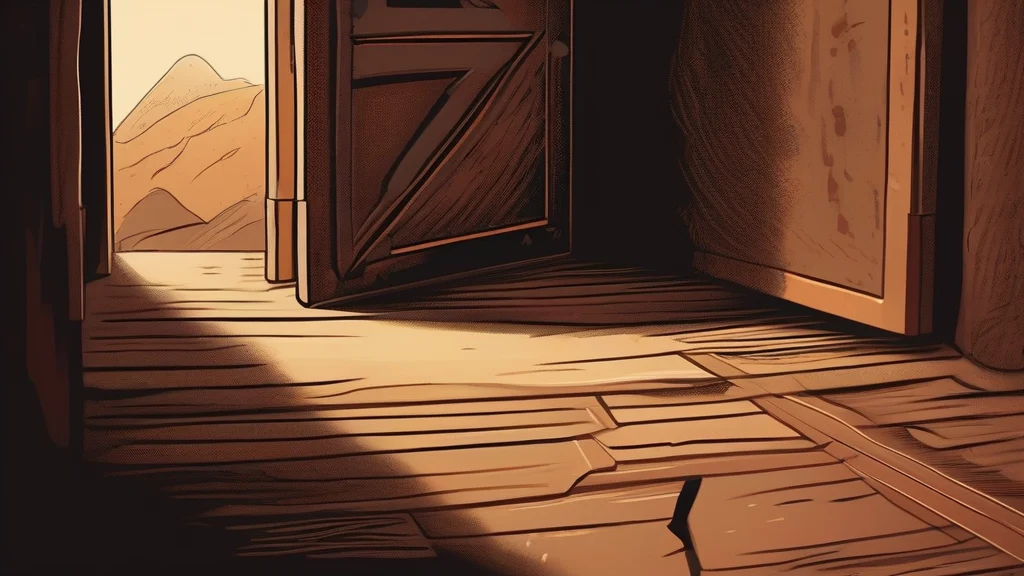
What does trapdoor mean?
A trapdoor is a hinged, removable, or sliding door set into a floor, ceiling, stage, or other horizontal surface. It may conceal a cellar, crawl space, shaft, or storage area, and in a theatre it can form part of a mechanism for raising, lowering, or revealing performers and scenery. In ordinary use, the word is concrete and functional, though it can also suggest secrecy, surprise, or a hidden route because the opening is not obvious from the surrounding surface. “Trapdoor spider” is a familiar compound: these spiders line burrows with silk and often construct a hinged, camouflaged door at the entrance. Trapdoor is normally treated as a countable noun, with trapdoors as its plural. The closed compound is standard in modern English, although “trap door” is also used. The word is especially useful when describing concealed openings in buildings, stages, platforms, and underground spaces.
nounA hinged or removable door set into a floor, ceiling, stage, or similar surface to close an opening. In theatrical contexts, it may conceal or reveal performers, scenery, or objects.
- A hinged or removable door covering an opening in a floor, ceiling, or similar surface.
- A movable panel or opening in a stage or platform used to conceal or reveal performers, scenery, or objects.
"The old cellar had a heavy wooden trapdoor that creaked as it swung open."
"She lifted the trapdoor and looked down into the dark cellar."
"The actor disappeared through the stage trapdoor at the end of the scene."
Trapdoor is a countable noun and takes the regular plural trapdoors when referring to more than one door.
"Several trapdoors were opened across the warehouse floor."
Trapdoor spiders line their burrows with silk and often add a hinged, camouflaged door that can seal them safely inside.
Reviewed by Deb Chak, Editor. AI-assisted content curated by RJS Tech Solutions LLP.
Where does trapdoor come from?
Trapdoor is an English compound formed from “trap” and “door,” and it was recorded in English by the 16th century. Its elements have distinct histories: “trap” descends through Middle English from older Germanic forms associated with a snare or trapping device, while “door” comes from Old English duru, ultimately related to Latin porta. The compound combines these established English words in their familiar sense of a door that closes or conceals an opening.
How trapdoor is actually used
The word is neutral and commonly countable. The closed compound “trapdoor” is standard in modern English, although the two-word form “trap door” is also encountered.
Easily confused with trapdoor
A hatch may be any removable covering over an opening, whereas a trapdoor is typically hinged and set into a floor, ceiling, or stage.