
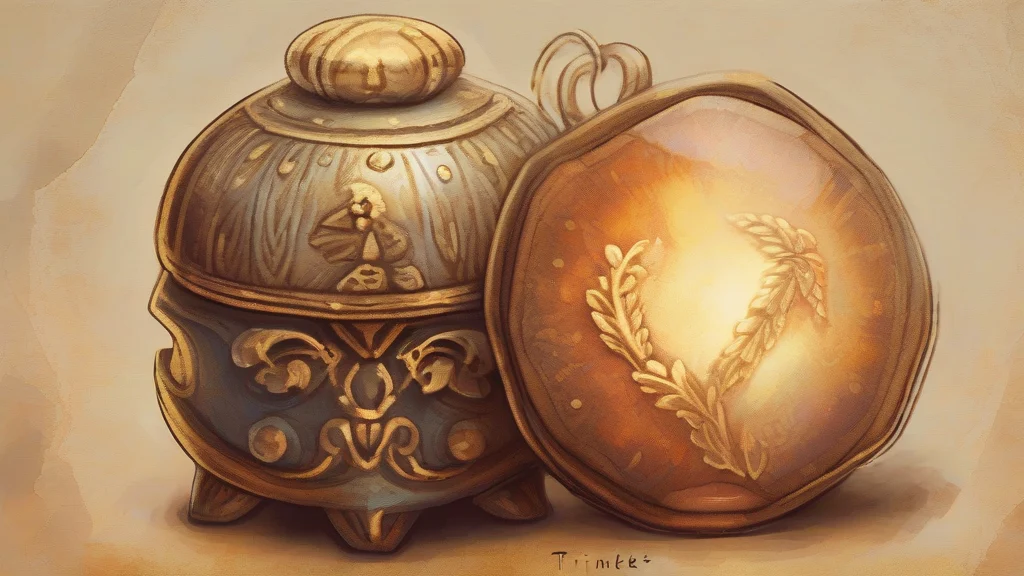
What does trinket mean?
A trinket is a small decorative object, especially a piece of jewelry or ornament. In contemporary English, the noun is most often used figuratively for an object of little importance or value: “The silver pin was valuable to its owner, though objectively a mere trinket.” The word can therefore carry a dismissive tone, especially when it describes something as merely decorative or inconsequential, while referring literally to an ornament it is usually neutral. “Trinket” appears in both British and American English and is a familiar, slightly old-fashioned word rather than specialist terminology. It is useful because it combines a concrete history as a name for small ornaments with a broader figurative meaning for anything regarded as trivial or insignificant. Although “knickknack,” “bauble,” and “ornament” overlap with it in meaning, “trinket” often suggests something small and visually decorative, while its dismissive use implies that the speaker considers it unworthy of serious attention.
nounA small decorative object, especially a piece of jewelry or ornament. By extension, it means an object considered trivial, insignificant, or of little value.
- A small decorative object, especially a piece of jewelry or ornament.
- An object regarded as trivial, insignificant, or of little value.
"She kept the antique brooch in a velvet-lined box, though it was little more than a trinket."
"The little charm was a charming trinket rather than an expensive piece of jewelry."
"Critics dismissed the proposed reform as a political trinket with no practical effect."
The plural is regular and takes the ending -s.
"The shop sells colorful trinkets, key rings, and other inexpensive novelties."
Trinket began as a name for small ornaments before turning into a dismissive word for anything deemed trivial.
Reviewed by Deb Chak, Editor. AI-assisted content curated by RJS Tech Solutions LLP.
Etymology of trinket
The word is attested in Middle English for a small ornament or piece of jewelry. Its deeper origin is uncertain, and no remote cognates can be identified with confidence. It later acquired the figurative sense of an object considered trivial or of little value.
Related word forms
How trinket is actually used
When used literally, the word is generally neutral. In figurative use, it is often dismissive, implying that something is too small, trivial, or insubstantial to matter.