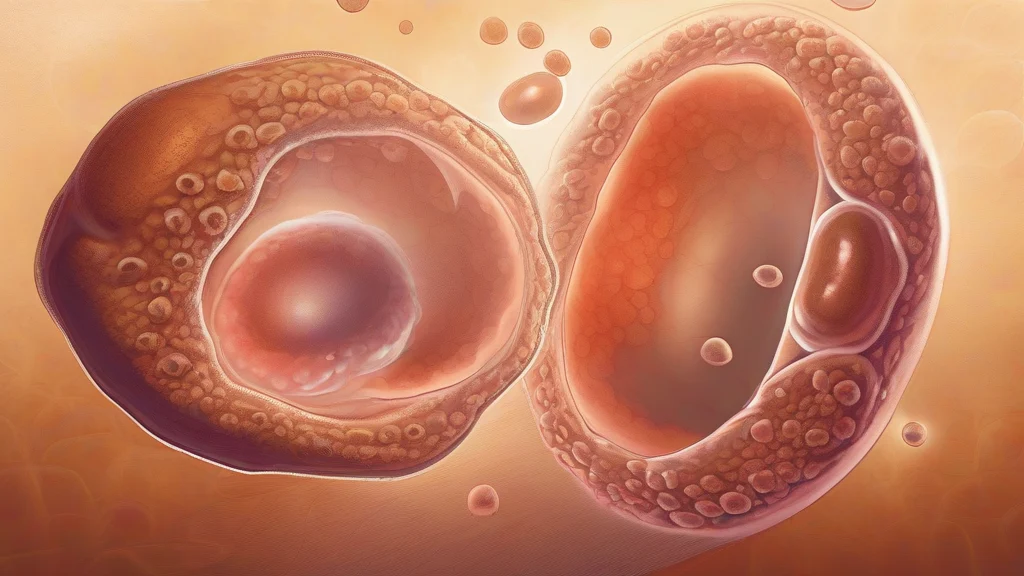
What does trophoblast mean?
The trophoblast is a critical component of the early stages of pregnancy, playing a vital role in the development and implantation of the embryo. It is the outer layer of cells in the blastocyst, a structure that forms after fertilization. The trophoblast provides essential nutrients to the embryo and eventually develops into the placenta and other supporting tissues necessary for fetal growth. Understanding the trophoblast is important for research into pregnancy complications and the development of reproductive technologies. Its study has implications for improving fertility treatments and managing pregnancy-related health issues.
nounThe trophoblast is the outer layer of cells in a blastocyst, which provides nutrients to the embryo and develops into the placenta and other supporting tissues during pregnancy.
- The outer layer of cells in a blastocyst.
- A layer of cells that develops into the placenta and other supporting tissues.
"The trophoblast plays a crucial role in the implantation of the fertilized egg in the uterus."
"The trophoblast differentiates into two layers: the cytotrophoblast and the syncytiotrophoblast."
"Abnormalities in trophoblast development can lead to pregnancy complications."
Countable, used to refer to multiple layers or types of trophoblasts.
"The researchers studied the development of trophoblasts in vitro."
Reviewed by Deb Chak, Editor. AI-assisted content curated by RJS Tech Solutions LLP.
Etymology of trophoblast
The term 'trophoblast' originates from the Greek words 'trophos', meaning 'nourishing', and 'blast', meaning 'germ'. It refers to the layer of cells that nourishes the embryo during early development.
How trophoblast is actually used
Formal and scientific contexts, often used in biology and medicine.