
What does tuatara mean?
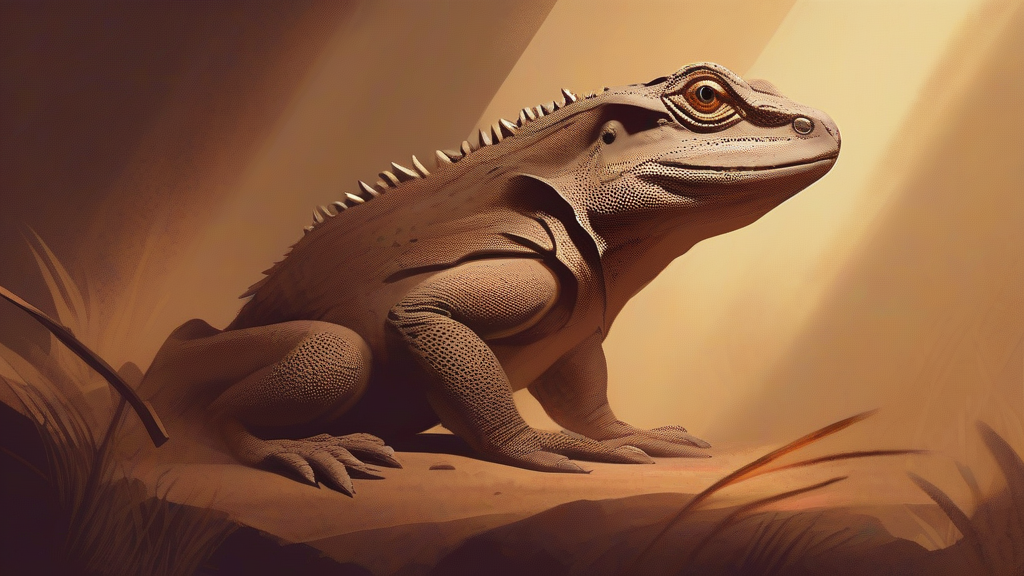
A tuatara is a distinctive reptile endemic to New Zealand. It has a stocky, lizardlike body, a row of pale spines along its back, and a small parietal eye in its skull that is most visible in young animals. Although commonly called a lizard, the tuatara is not a true lizard: it is the only surviving member of the order Rhynchocephalia, an ancient lineage that once included many species. Tuataras inhabit coastal areas and offshore islands, where they shelter in crevices and forage for insects, worms, and small vertebrates. The word comes from Māori and is now used in New Zealand English and international zoological writing. Tuatara became especially familiar to the public through conservation campaigns, sanctuary projects, and the long-running effort to protect populations on islands such as Tūhua. Its combination of ancient evolutionary status, distinctive appearance, and cultural importance makes it especially memorable.
nounA nocturnal, lizardlike reptile, Sphenodon punctatus, endemic to New Zealand, with a spiny back and a small parietal eye in the roof of its skull. A tuatara is the only living representative of the ancient reptile order Rhynchocephalia.
- The tuatara is a spiny, nocturnal reptile native to New Zealand and the sole living member of the order Rhynchocephalia.
"A tuatara basked on the warm rocks near the coastal shelter."
"Conservationists carefully monitored the tuatara population on a remote island sanctuary."
"In Māori culture, the tuatara has long been associated with the island of Tūhua, formerly known as Little Barrier Island."
The plural tuataras is standard, though tuatara is also used with both singular and plural meanings, particularly in New Zealand English.
"Sanctuary staff counted hundreds of tuataras during the annual survey."
A tuatara is a living remnant of an ancient reptile lineage that survived long after the dinosaurs disappeared.
Reviewed by Deb Chak, Editor. AI-assisted content curated by RJS Tech Solutions LLP.
Etymology of tuatara
The English word was borrowed from Māori tuatara, the native name of the reptile. The compound is commonly analysed as tūā, meaning “toad,” together with tara, referring to something spiny or thorny, perhaps describing the animal's rough appearance. It entered English zoological usage during the early 19th century.
How tuatara is actually used
In English, the word is chiefly a zoological term. Although it is related to true lizards, a tuatara belongs to a separate evolutionary lineage and is more precisely described as a tuatara lizard or rhynchocephalian.